
By Michael Grey*

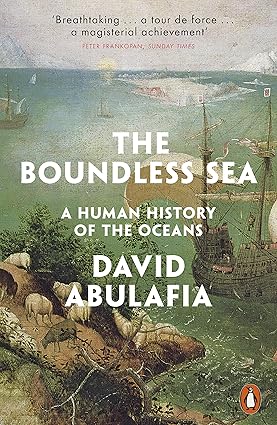
“Hormuz commanded the traffic along the shores of the Indian Ocean, linking what are now Oman and Pakistan, as well as the traffic through the Strait of Hormuz up to Basra in Iraq.” It was “a dust blown port with no natural resources, but with as many as 40,000 inhabitants.” Seeking some light relief from current world events, I have been reading David Abulafia’s huge and fascinating The Boundless Sea – a human history of the oceans, which is exactly what it says in the title and traces the interaction of mankind with the watery wastes since the dawn of human times.
It is an astonishing piece of work and if you are trying to put maritime history into a global context, rather than the somewhat Eurocentric dimension many of us have been brought up with, it is compulsive reading, as the author ranges between the various oceans which wash our respective shores, over millennia.
It was nearly 700 pages into this story that the word “Hormuz” suddenly exploded onto the pages, with Abulafia’s account of the Portuguese 16th century maritime empire and their efforts to bludgeon their way into a route for eastern spices to reach European markets that did not require the hazardous voyage around South Africa. And it is a gripping tale, with the difficulties of forcing the heavily contested passage through the Red Sea, or alternatively, securing the Arabian Gulf, replicating the power politics of today in a somewhat eerie fashion.
Portuguese admiral a Hormuz bully…
There is even a Trump-like character, in the terrifying Portuguese Admiral Alfonso de Albuquerque, whose policy of extreme violence, “that spared neither women nor children” bullied Hormuz into submission when his fleet arrived on the scene in 1507. They were to keep their tight control over what they recognised was a strategic location for their trade for more than a century. The ruins of their forts and defences are still visible today.
In a curious fashion, this forensic examination of power politics in those days puts an interesting perspective on current events in that turbulent but strategically vital location. It was important to those who contested those waters then, for much the same reasons as they are considered vital to world trade today, as silks, spices and the riches of the east have given way to energy and agricultural cargoes.
One somehow suspects that these historical perspectives might be considered irrelevant to the various contestants as they trade their demands for a peace settlement that might get traffic flowing and the strait once again a properly recognised international waterway. Both the US and Iran have shown willingness to enforce their respective “blockades” by force and there is no great optimism that the plight of the marooned ships and their crews will be ended soon.
The current dilemma of marooned ships and crews
The boast that Iran’s navy had been “obliterated” (a word that was probably in the vocabulary of Admiral Albuquerque) seems to have lacked complete credibility, with its “mosquito fleet” of small craft still demonstrating their capabilities.
A neighbour, who is a former army officer, asked me over the garden fence “if a modern navy, with its vast resources and complete air superiority, can’t defend itself against speedboats and jetskis, is there any point in them?” There is no obvious answer, except perhaps to wonder whether the military mindset has completely adjusted to the sort of wars that are being fought today with their drones and swarms and missiles? Might this be a case once again of today’s generals fighting yesterday’s war? Beyond my pay grade.
Another relevant question might be whether the protection of merchant shipping is still a role for navies, when the ownership of those merchant ships is so opaque? Which ship is any multi-national force of warships supposed to protect, or is the protection “flag-blind”? This was not the case in the Iran -Iraq confrontation in the 1980s, when there was all sort of desperate reflagging undertaken to join a convoy under a naval umbrella. Why should the US, or any other taxpayer, pay to supply protection for ships under convenient flags, with no connection to the protecting naval units? It is possible that this sort of question will arise again, as history, repeats itself.
(Photo of the cover of the book by David Abulafia)
*Michael Grey is former editor of Lloyd’s List. This column is published with the kind permission of The Maritime Advocate.