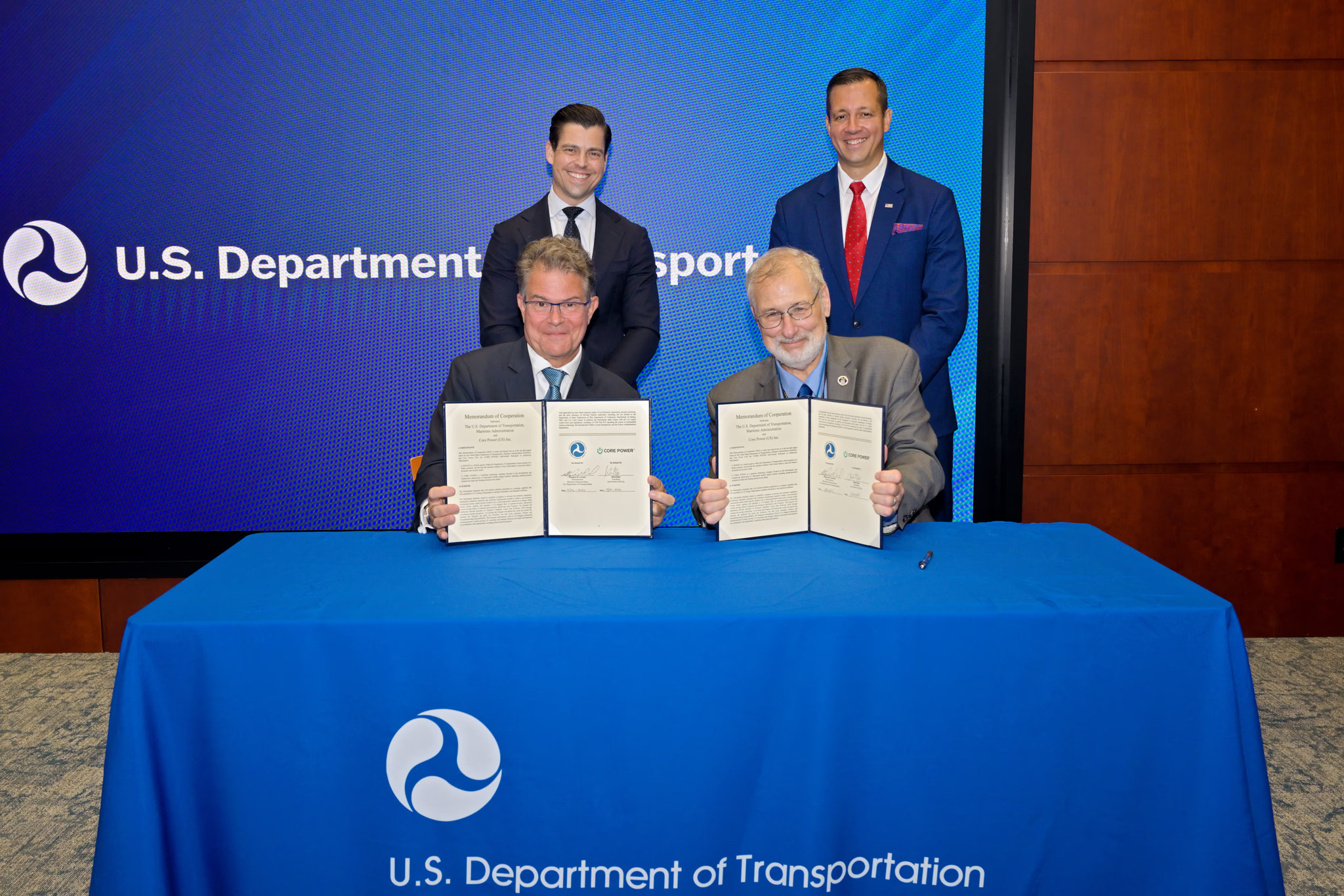
The U.S. Department of Transportation’s Maritime Administration (MARAD) and CORE POWER (US) Inc. announced a first-of-a-kind federal-private cooperation framework to accelerate the commercial, industrial and regulatory pathway for a future fleet of U.S.-flagged nuclear-powered merchant ships. CORE POWER is targeting first construction from 2028.
The strategic context is urgent, stated a press release. China dominates global commercial shipbuilding and is actively developing nuclear-powered commercial shipping, with state-owned shipbuilders promoting nuclear-powered merchant-vessel concepts and building relevant nuclear manufacturing capability. President Trump’s Maritime Action Plan is intended to reverse U.S. maritime decline, mobilize private investment and rebuild an industrial base the Administration has identified as central to economic and national security.
Mikal Bøe, Founder and CEO of CORE POWER, said: “China is already moving toward nuclear-powered commercial shipping. That should focus minds in Washington. America does not regain maritime strength by building a better version of yesterday’s ship.
“The United States has seven decades of nuclear-at-sea experience, world-class allies and the nuclear expertise to lead the next generation. Japan and Korea can accelerate conventional ship construction while America builds the specialist nuclear-grade integration and lifecycle capability at home – capability that can also strengthen the wider maritime industrial base.”
Stephen M. Carmel, Administrator of the Maritime Administration, said: “President Trump has made it clear that American energy dominance and maritime strength go hand in hand. This framework ensures that the United States leads the world with a secure U.S.-flagged fleet. Nuclear propulsion is a serious commercial opportunity, but it must be approached as a complete system – safe, secure, licensable, and investable.”
The goal of the Memorandum of Cooperation (MOC) is to turn policy into an actionable commercial pathway. It creates a forum for government, industry and other stakeholders to work through regulatory acceptance, port operations, workforce credentialing, fuel and lifecycle services, insurance and finance, industrial capacity and potential federal demand structures. Reducing uncertainty across these areas will enable private capital to commit to ships, yards and supporting infrastructure.
This follows agreements between the ports of Long Beach and Corpus Christi to sign an agreement with MARAD to study small modular reactors.
(Photo from MARAD)