
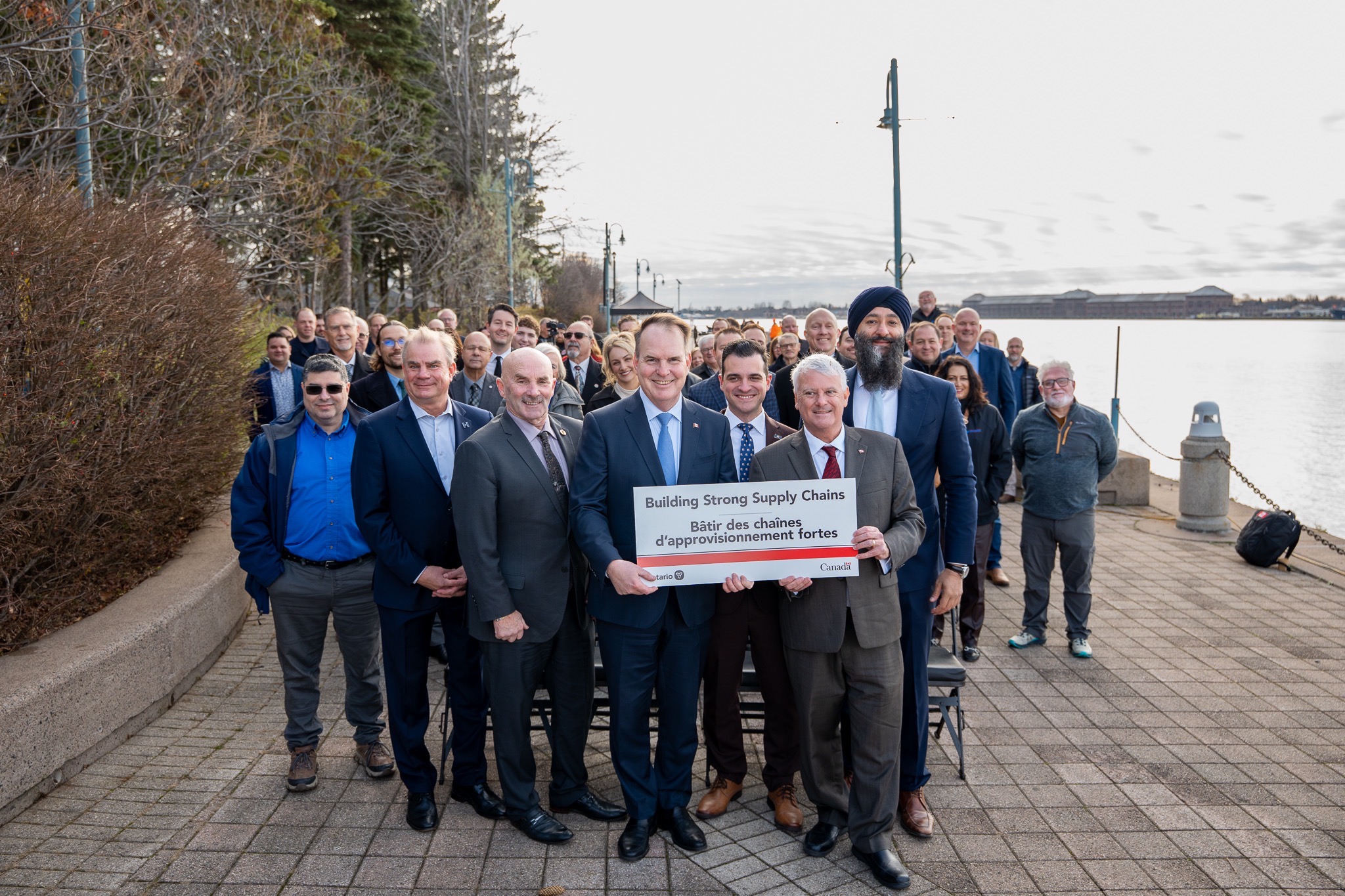
HOPA Ports and the City of Sault Ste. Marie announced today that, with funding commitments secured from the federal and provincial governments, they will build a $250-million multimodal port and industrial hub in Sault Ste. Marie.
The investment will strengthen Canada’s trade infrastructure, expand industrial capacity and connect Northern Ontario businesses with domestic and global markets.
The Honourable Steven MacKinnon, Minister of Transport, announced $125 million in federal funding through the Trade Diversification Corridors Fund (TDCF), while the Honourable Prabmeet Sarkaria, Ontario’s Minister of Transportation, announced the Province of Ontario’s intention to provide a $125-million loan.
“Building one Canadian economy means investing in the infrastructure that connects our regions, strengthens our supply chains, and helps Canadian businesses reach customers at home and abroad,” said Minister MacKinnon. “The Port of Sault Ste. Marie project will create new trade opportunities, support economic growth across Northern Ontario, and reinforce Canada’s position as a reliable and competitive trading nation.”
As Canada works to strengthen domestic supply chains, build industrial capacity and diversify export markets, the Port of Sault Ste. Marie will provide critical trade-enabling infrastructure linking Northern Ontario’s resource economy with Southern Ontario’s manufacturing base and customers around the world.
“Canada has an enormous opportunity to build more, process more and move more goods here at home, but that requires infrastructure that connects resources, industry and markets,” said Ian Hamilton, President & CEO of HOPA Ports. “This project will help link Northern Ontario’s resources and industrial production with manufacturers, processors and export markets, creating the connections Canadian industry needs to grow.”
Northern Ontario industries poised for growth include mining and critical minerals, steel, forest products, advanced manufacturing and construction materials.
The new port will include marine berths, rail transload facilities, cargo-handling areas, utilities and tenant-ready industrial lands designed to attract investment in these sectors.
Once operational, the port is expected to handle more than 2.4 million metric tonnes of cargo annually, giving businesses more transportation options and stronger connections among suppliers, processors, manufacturers and export markets.
REVITALIZING STRATEGIC INDUSTRIAL LAND
The project will transform approximately 243 acres of underused industrial and brownfield land into a productive trade and industrial hub, creating long-term economic opportunities amid global trade disruptions and tariffs.
The development is expected to attract investment, diversify the local economy and strengthen Sault Ste. Marie as a centre for transportation, manufacturing and industrial growth.
“For decades, economic diversification has been the most pressing challenge facing Sault Ste. Marie, and building the Port of Sault Ste. Marie represents a breakthrough in our community’s efforts to create a stronger local economy and brighter future,” said Matthew Shoemaker, Mayor of Sault Ste. Marie. “The City is proud to have worked alongside our partner in HOPA Ports to make this happen, and we’re grateful for the support of the Federal and Provincial governments.”
Work in 2027 will focus on land arrangements, Indigenous partnerships, environmental and technical investigations, regulatory review and detailed design. Subject to approvals, site preparation could begin in 2028, followed by major marine, road, rail and utility construction in 2029. Full buildout is targeted for 2031.
JOBS AND ECONOMIC IMPACT
Construction is expected to support approximately 1,270 jobs in the engineering and construction phase. Once fully operational, port-enabled activity is projected to sustain up to 4,750 direct and indirect jobs annually and generate approximately $933 million in annual GDP.
As the port expands, it will support jobs in cargo handling, marine and rail services, transportation, warehousing, equipment operation, maintenance and logistics. Tenant-ready industrial lands will also enable employment growth in mining and critical minerals, steel, forest products, construction materials, manufacturing and agri-food.
“The trade corridors we build today will shape where Canadian industry grows tomorrow. By connecting Northern Ontario’s resource economy with processors, manufacturers and global markets, the Port of Sault Ste. Marie can strengthen Canada’s supply chains, expand export opportunities and help build a more resilient economy in an uncertain world,” added Mr. Hamilton.
Commercial outreach has identified strong demand for expanded transportation capacity. HOPA Ports and the City have consulted more than 40 companies and organizations across manufacturing, mining, forestry, agriculture, transportation and marine services.
(Port photo from HOPA and group image from Transport Canada)