
By Leo Ryan, Editor
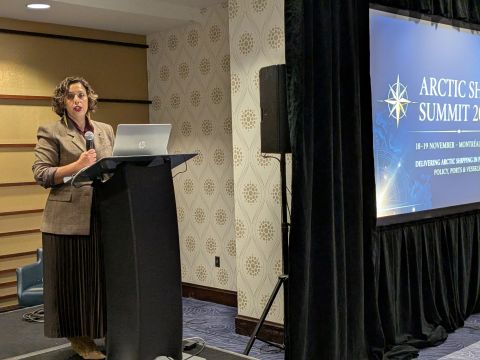
If there was any doubt that the Arctic was having a moment, it was rapidly put to rest today by the rousing, insightful opening remarks by Sima Sahar Zerehi at the two-day ACI Arctic Shipping Summit which put many things in perspective from growing sovereignty issues to partnering with Inuit communities on future nation-building projects.
“Sovereignty isn’t built by showing up. It’s built by investing in the people who never left,” underlined the CEO and co-founder of the Arctic Opportunities Group, a women-owned advisory firm advancing infrastructure and economic development across Nunavut and the circumpolar North.
“It’s fitting that we’re meeting here,” she began. “Every summer, sealift ships leave from ports just outside Montréal, at Sainte-Catherine [sant-kat-RIN], Valleyfield [va-lay-FEELD] and Bécancour [bay-kahn-KOOR], carrying what Arctic communities need for the year ahead: building materials, the family car, boats, skidoos. For many northerners, this stretch of the St. Lawrence is where the year’s most important deliveries begin.”
Then Ms. Zerehi launched into wide-ranging observations by stating: “The Arctic is having a moment. Across the circumpolar world, geopolitics are shifting and investment is accelerating. Governments that once looked north now and then are now looking north with urgency.
“A conference like this one is not simply about shipping. It isn’t only about ports, fuel, vessels and icebreakers, although we’ll talk a great deal about all of those today. It’s about something bigger: what it means to build a nation, and who gets to do the building.”
Shipping’s new meaning in security conversations
Continuing, Ms. Zerehi declared: “Shipping takes on new meaning in the middle of today’s sovereignty and security conversations. A port is no longer just a port. A corridor is no longer just a route. The same infrastructure that moves cargo also supports defence, search and rescue, community resupply, and the critical minerals and major projects this country says it needs. Our job is to connect those dots (shipping, infrastructure, defence, resources and communities) instead of planning each one in its own silo.
“Arctic shipping has always been about connection. Long before anyone drew a shipping lane on a map, Inuit travelled and traded across the circumpolar North. Inuit are one people across four countries, from Chukotka and Alaska, across Canada, to Greenland.
“Today we’re talking about connection on a new scale: an east–west route across the top of the world, linking the Atlantic and the Pacific. Greenland to the east, investing in new airports and port capacity. Qikiqtarjuaq, on Baffin Island’s east coast, where Inuit-led partners are advancing a long-awaited deep-sea port. Nunavut and Hudson Bay at the centre. Grays Bay and the Western Arctic, which we’ll hear about this morning, opening toward Alaska and Asia. This year, the Port of Nuuk signed an agreement with the proponents of both the Qikiqtarjuaq and Grays Bay ports to work together. Each of these is a piece of the same map.
Canada’s challenges in nation-building
“The question for Canada is whether we treat them as scattered projects, or as one connected circumpolar corridor that serves trade, security and, above all, the communities along it. Greenland, Norway, Iceland and Alaska all offer lessons on building that kind of economy with northern people at the centre rather than the margins.
“And for the first time in a generation, the tools are in place. Defence is projecting about $40 billion in northern infrastructure over the next 20 years. The Building Canada Act and the Major Projects Office are designed to move nation-building projects faster, and the Canada Infrastructure Bank is there to help finance them. These are historic investments, and they were made for nation building.
“So this is the time to be visionary and aspirational. Not to pit one project against another, one port against another, or one region against another. Ports in isolation won’t meet the need. Navigating the Arctic takes interconnected networks: ports and airports, roads and corridors, energy and fibre, resupply and search and rescue, all working together. That’s how we truly connect Canada, from east to west and from north to south.”
Inuit regions weighing options
Turning to perspectives from the point of Inuit regions, Ms. Zerehi noted: “Inuit regions are weighing options around marine conservation and oil and gas exploration. A sustainable Arctic seaway that supports Inuit participation in the blue economy is the goal.
“On April 1, 2027, through devolution, Nunavut will take control of its lands and resources. And yesterday, the Kitikmeot Inuit Association marked 50 years: 50 years of advocacy, negotiation and building.
“That anniversary tells us something. Inuit organizations and development corporations are coming of age. They are owners, investors, partners and decision-makers, not stakeholders to be consulted at the end of a process.
“I saw that clearly this year. On the Greenland trade mission, we saw what Inuit-to-Inuit economic diplomacy looks like: Inuit leaders talking ports, energy, training and trade on their own terms. And at a recent defence infrastructure and procurement gathering, the message I took away was simple. Nothing will move forward in the North without the leadership and partnership of Inuit and Indigenous organizations.
“Canada’s past efforts to assert Arctic sovereignty were not always made with Inuit, and too often came at their expense. This moment gives us the chance to build a different Canada, with Inuit leading. A Canada where the Arctic is no longer seen as a cost to be managed from the south, but as an economic engine for the whole country,” Ms. Zerehi stressed.
(Photo from ACI)