By Leo Ryan, Editor
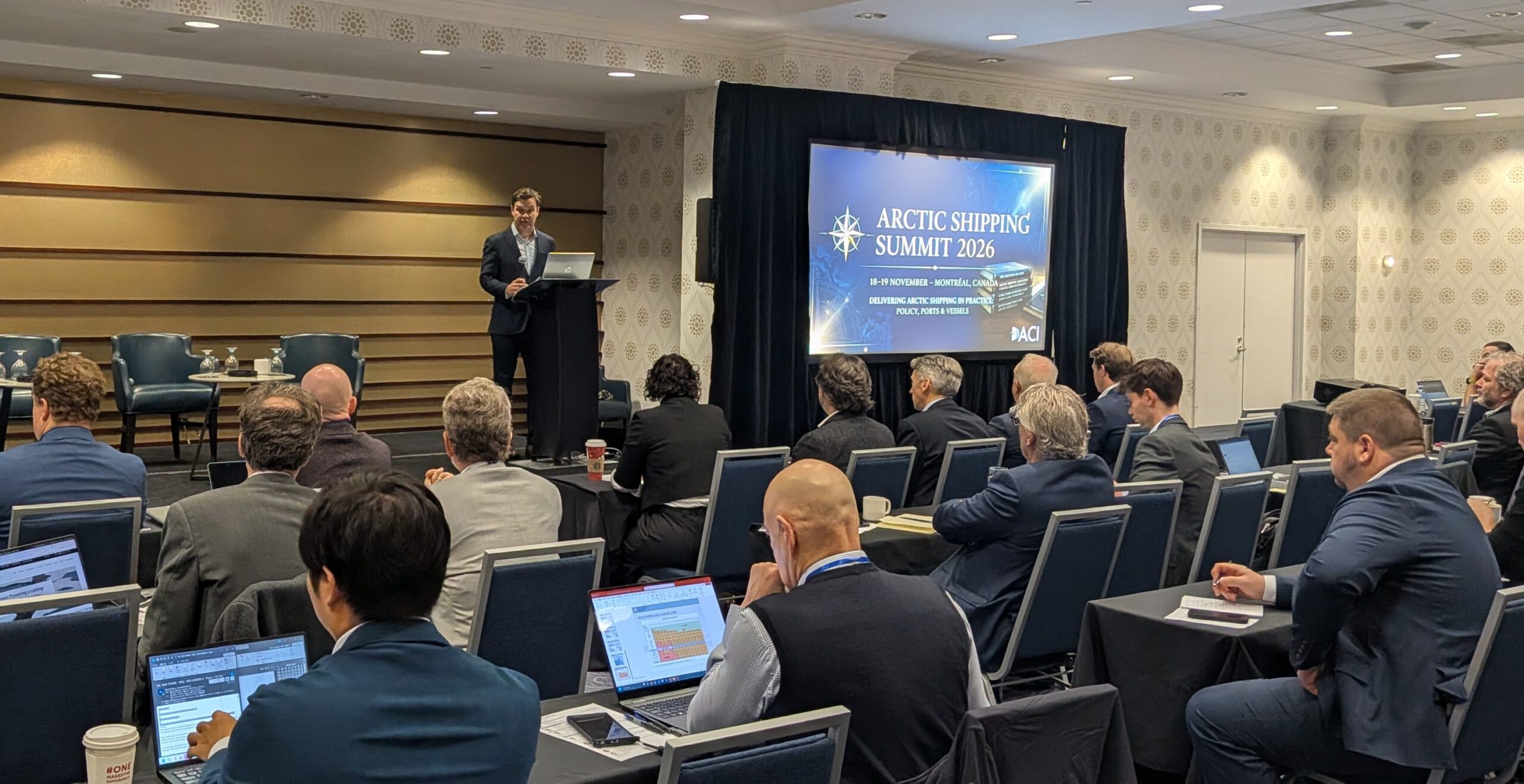
In a keynote address today to the Arctic Shipping Summit in Montreal, Matt Jeneroux, Special Advisor to Prime Minister Carney on Economic and Security Partnerships, stressed how the Far North has become “an important part of Canada’s economic future as well as our sovereignty.”
His comments touched on a wide variety of Arctic-related subjects in a world where “trade relationships are shifting, supply chains are being reassessed and geopolitical competition is intensifying. Countries are thinking differently about economic security and access to markets. For Canada, that presents real challenges, but also real opportunities.”
“Too often we talk about the North primarily in terms of its geography, its climate or the challenges of operating there. Those things matter, of course. But the North is also home to communities, significant natural resources and enormous economic potential,” said the MP for Edmonton Riverbend.
On the future of Arctic shipping, Mr. Jeneroux foresees “enormous potential for Canada. We have the natural resources, the geographic position, the talent and a strong maritime tradition. But realizing that potential will take more than infrastructure projects and government investment.
“It will take sustained collaboration between industry and governments, meaningful partnerships with Northern Indigenous communities and a commitment to getting the details right. It will also require us to think beyond the immediate economic benefits and consider the kind of Arctic we want to build. We have to keep asking ourselves who these investments serve, how their benefits are being shared and what responsibilities come with them.”
Sharing his thoughts on how Arctic shipping fits into Canada’s changing economic landscape, Mr. Jeneroux began by referring to the traditionally strong relationship with the United States which has been impacted by a trade war ignited by the Trump administration.
Diversifying Canada’s trade
“That relationship remains important. But recent developments have reminded us that we cannot afford to rely too heavily on a single market. We need to diversify our trading relationships, strengthen partnerships with reliable international partners and give Canadian businesses more opportunities to compete globally.
“Our engagement in the Indo-Pacific is a great example. ASEAN is a dynamic and increasingly important economic region, with growing markets and opportunities for Canadian businesses. Japan and South Korea are also important partners, particularly in areas such as energy, critical minerals, technology and advanced manufacturing.
“We may also have the opportunity to work more closely with these countries on maritime technology, shipbuilding, research and safe Arctic navigation. Japan and South Korea, for example, have significant maritime capabilities and an interest in understanding how Arctic shipping will evolve. I see this as an area where Canada’s international partnerships and our northern economic ambitions can complement one another.”
Building northern infrastructure
“But international partnerships are only part of the picture,” Mr. Jeneroux shared.
“We also need to build the infrastructure at home that makes these opportunities possible. For Canada’s North, that means better transportation connections, more reliable supply chains and infrastructure that supports economic development and connects northern businesses to domestic and international markets.
“That is why Budget 2026 puts a significant emphasis on major projects and northern connectivity. Three initiatives are particularly relevant to this conversation: Port of Churchill Plus in Manitoba, the Grays Bay Road and Port in Nunavut, and the Mackenzie Valley Highway in the Northwest Territories. Each is at a different stage of development and has its own challenges. Together, they illustrate the economic potential of improving northern transportation infrastructure and connecting it to Canada’s broader ambitions.”
The role of private investment
Turning to investment issues, Mr. Jeneroux noted that one should also recognize that (government) infrastructure investment alone cannot deliver these opportunities. “We need private sector participation and the confidence of businesses willing to make long-term investments.”
One measure in Budget 2026 worth watching, he said, is the proposed productivity measure that would allow businesses to immediately expense a broad range of eligible capital investments.
“The opportunity in front of us is not just potential. It means tangible economic benefits: better connections, stronger businesses, more trade, good jobs and a more diversified Canadian economy.”
Operating safely in the Arctic
Generally speaking, Mr. Jeneroux stressed the importance of Canada’s ability to ensure safe and reliable maritime operations in the Arctic. Adequate icebreaking capacity is essential to supporting northern resupply, assisting vessels in distress, keeping waters navigable and maintaining Canada’s presence in the North.
In August, the federal government awarded an $11.3 billion contract for the design and construction of six new Canadian Coast Guard Program Icebreakers. These vessels will replace ageing heavy and medium icebreakers and strengthen Canada’s ability to support operations in northern waters. The project is also expected to create nearly 5,000 jobs during construction and contribute approximately $650 million annually to Canada’s GDP.
But Mr. Jeneroux also said one should remember that icebreakers are only part of the equation. “We also need trained crews, reliable communications and navigation information, adequate maintenance facilities, and effective search and rescue and emergency response capabilities across such a vast and challenging region. These elements need to work together so that vessels can operate safely and help is available when something goes wrong.”
Protecting the marine environment
“Marine safety must also go hand in hand with environmental protection. In September, the federal government announced a $1.2 billion investment over four years to support ocean protection, marine safety and emergency preparedness. This is particularly relevant to the Arctic because it supports underwater noise monitoring and the assessment of its effects on marine mammals as vessel traffic increases.
“This matters. Marine ecosystems are sensitive, and we need a much better understanding of how shipping activity affects the wildlife and habitat that northern communities depend on. Environmental protection is not something to address after development has taken place. It needs to be part of the process from the beginning.”
Partnership with Northern Indigenous communities
Mr. Jeneroux continued: “That brings me to another fundamental consideration: meaningful partnership with Northern Indigenous communities. People who live in the North have generations of knowledge and experience in these environments. Their understanding of local conditions, marine ecosystems, wildlife and a changing Arctic environment is invaluable. That knowledge should be respected and incorporated into decisions about shipping, environmental protection and infrastructure development.
“But meaningful partnership goes beyond consultation. It means recognizing Indigenous leadership, creating opportunities for Indigenous ownership and businesses, investing in local skills and training, and ensuring communities have a genuine voice in decisions that affect their future.
“Some of the major infrastructure initiatives I mentioned earlier offer opportunities to put these principles into practice. At the Port of Churchill, for example, the Arctic Gateway Group demonstrates how Indigenous and local community participation can be built into the ownership and governance of a major transportation asset. This example points to an important principle. Northern Indigenous communities should not simply be consulted about development taking place in their regions. They should have a meaningful opportunity to shape it and share in its benefits.”
Sovereignty and international cooperation
“There is also an international dimension to all of this,” Mr. Jeneroux indicated. “Research, monitoring capabilities and operations in northern waters are becoming increasingly important. Sovereignty is not exercised simply by drawing lines on a map. It is about having the people, infrastructure, equipment and relationships necessary to be present and to exercise our responsibilities.
“That is why cooperation matters. Canada cannot address every Arctic challenge on its own. We need to maintain constructive relationships with our Arctic neighbours and other international partners to protect Canada’s interests, particularly in maritime safety, navigation and emergency preparedness. By working with industry and communities, and by building relationships with international partners, we can develop the capacity and partnerships we need to meet our responsibilities in the North.”
The people who keep the industry moving
“We spend a lot of time discussing infrastructure, investment, technology, shipping routes and regulations. All of those things are important. But none of them works without the people who operate the vessels, maintain the equipment, manage the ports and keep supply chains moving.
“Working at sea often means spending extended periods away from family and friends, in isolated environments, dealing with unpredictable conditions and carrying significant responsibility. In Arctic operations, those pressures can be even greater, and we need to talk more openly about the impact they can have on people’s mental health.
That is particularly important in an industry where men make up the vast majority of the workforce. For many men, asking for help can still be very difficult. Today is, in fact, International Men’s Day. It is a day of significance, and this issue is very close to my heart. I founded a foundation that focuses on raising awareness of men’s mental health, and one thing I’ve learned through that work is that many men still struggle to ask for help.”
“We need to create a culture where people feel comfortable speaking up, where colleagues look out for one another and where seeking help is seen as a normal part of looking after ourselves and each other. Ultimately, this is not just a men’s issue. Mental health affects everyone, and everyone deserves to be supported.
“We also need to recognize the importance of supporting families. When someone spends weeks or months working at sea, their family experiences that absence too. They carry their own pressures and responsibilities, often without the support network others may take for granted.
“For the maritime industry, that means employers taking workplace well-being seriously: making sure crews and their families can access mental health resources, training supervisors to recognize when someone may be struggling, and building a culture where asking for help is encouraged.
Greater mental health supports needed in the Arctic region
“Access to support can be especially challenging in Canada’s North. Budget 2026 proposes $1.2 billion to extend the existing federal agreements with provinces and territories for mental health and addiction services. That is an important commitment to maintaining access to services, but we must also consider how support reaches people whose workplaces are remote. A crew member should not have to wait until they return to shore to get help, and support should not depend on how close someone happens to be to a major community or healthcare facility.
“We need practical ways to make support accessible. This is something that industry, employers and policymakers should continue to give serious attention to, because workforce well-being is not separate from marine safety. It is an essential part of it.”
(Photo from ACI)