
The National Association of Waterfront Employers (NAWE) released new survey findings based on input from 25 senior port and terminal executives, revealing that U.S. ports require billions in near-term capital investment to maintain efficiency and global competitiveness.
Additionally, the survey found that there is demand for more than 100 new or replacement ship-to-shore (STS) cranes, underscoring the scale of modernization needed to accommodate larger vessels and maintain port efficiency.
The executives surveyed provided estimates on the costs associated with purchasing new STS cranes and cargo handling equipment (CHE), repairing existing assets, and upgrading terminal operations over the next five years.
The National Association of Waterfront Employers is a Washington based trade association whose member companies are privately owned stevedores, marine terminal operators, and other waterfront related employers. Member companies do business at major U.S Ports on the Atlantic and Pacific coasts, the Gulf of Mexico, the Great Lakes, Canada, and the Commonwealth of Puerto Rico.
According to the survey, respondents estimate that $6.7 billion in total investment will be needed for cargo handling equipment at U.S. ports over the next five years. Of that total:
- $2.74 billion is needed for new STS crane purchases
- $2.4 billion is needed for large yard cargo handling equipment and additional STS cranes
- $917 million is required for rail-mounted large yard cargo handling equipment
- $790 million is needed for repairs to existing STS cranes and cargo handling equipment at marine terminals
“These findings underscore the scale and urgency of the investment challenge facing U.S. ports,” said NAWE President Carl Bentzel. “Modern cargo handling equipment is essential to ensuring terminal productivity, supply chain resilience, and the ability of U.S. ports to compete with international gateways. To invest in this equipment is an investment in securing America’s future and supply chain, and will be the lynchpin to unlock tens of billions of private sector investment in related intermodal infrastructure.”
The survey highlights the increasing cost pressures facing port operators as cargo volumes grow, vessels become larger, and equipment ages. Respondents emphasized that sustained capital investment—supported by public-private collaboration—will be critical to keeping pace with global competitors and meeting the demands of exporters, importers, and American consumers.
In addition to the survey, NAWE has formally requested clarification from the Office of the U.S. Trade Representative (USTR) regarding the Administration’s tariff policies affecting STS cranes and other large CHE. In a letter (linked here) to USTR Ambassador Jamieson Greer, NAWE emphasized that its member companies –who collectively handle more than 90 percent of the nation’s containerized trade–are facing significant uncertainty as they plan for these multibillion-dollar capital investments.
Issue of Chinese-manufactured cranes
The letter raises key questions about the implementation of the one-year pause on tariffs for Chinese-manufactured STS cranes and large yard CHE, including how the policy applies to equipment orders, deliveries, and parts. NAWE also highlighted concerns about the gap between current U.S. manufacturing capacity and immediate port infrastructure needs, noting that a lack of clarity could delay critical equipment purchases.
“Having clarity on tariff policy is essential for terminal operators making long-term investment decisions in our nation’s ports,” Mr. Bentzel added. “Uncertainty risks delaying projects that are vital to maintaining the efficiency of the U.S. supply chain.
NAWE plans to use the survey results to inform policymakers, stakeholders, and industry partners as its membership blankets Capitol Hill this week and discussions continue around infrastructure funding, port competitiveness, and long-term supply chain resilience.
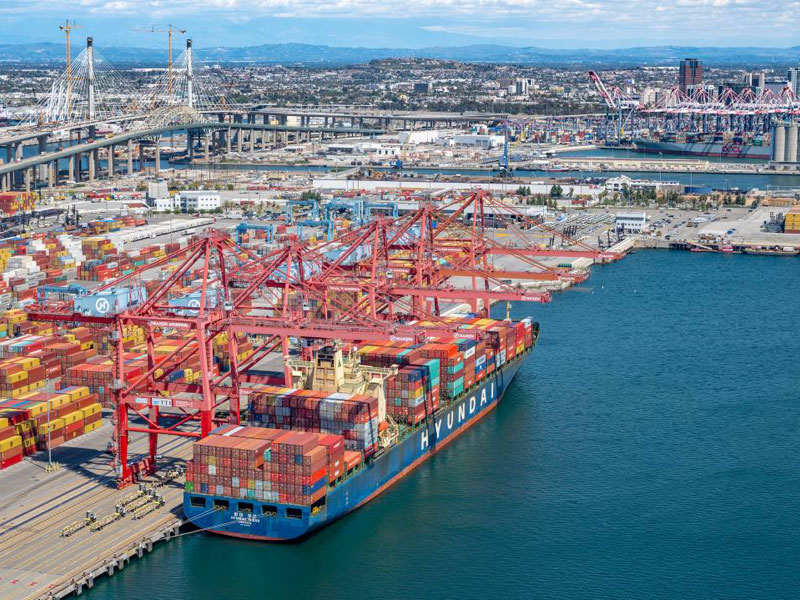
(Photo of Port of Long Beach)