
Green Marine concluded its annual GreenTech conference in Quebec City on June 11th after two-and-a-half days of keenly discussing everything from expanding decarbonization to leveraging a smaller port’s resources to further reducing underwater noise.
Éric-Martin Gallant, the Director of Environment at Chantier Davie Canada Inc., talked about more than $800 million being invested over the next few years to modernize its shipyard facilities well beyond regulations for noise mitigation, dust control, and water runoff control.
“Just to give you an idea, there’ll be 16 dust collectors in one of the renovated buildings,” Mr. Gallant shared. “And because it’s literally 50 metres from a residential neighbour, we’re working with Soft dB and other companies to ensure that we don’t disturb the citizenry with noise.”
Groupe Océan has added sustainability clauses into the $3 billion worth of supplier contracts signed across Canada under the national shipbuilding strategy. “We’re leveraging our purchasing power to improve sustainability up and down the chain,” says Frédéric Maloney, the Executive Director – Health Safety and Environment.
In terms of emissions, Groupe Océan has achieved a 16% reduction within its vessel fleet over the past three years. Mr. Maloney cited the importance of keeping proper track of data to remain focused on goals and clearly accountable to customers.
Carl Laberge, Port Saguenay’s CEO, noted the positive community response for a new kind of industrial park planned for development over time on the port’s 12 km2. The concept’s walkways, trees and other greenery put more of an emphasis on the park aspect.
The Port of Matane has been working with Norda Stelo on the plans to renew the port that will see its single berth at the end of its lifecycle by 2033. “It goes without saying that with just one berth and limited storage the port no long meets the needs of its users,” said Caroline Ratté, Director of the Environment and Sustainable Development at la Société du Bas-Saint-Laurent et de la Gaspésie.
Stephan Ferrero, Norda Stelo’s Director of Ports and Coastal Engineering, says that ultimately having two new berths will satisfy the Quebec government’s requirement of taking more trucks off roads with the project. The new facilities will be constructed to accommodate expected sea level rise and be scheduled in a way that avoids disrupting regular port operations.
While the goal is to eventually have shore power, Mr. Ferrero acknowledges that might take some time.
Ports challenged by big increases in energy demand
Claude Comtois, a Geography professor at l’Université de Montréal, noted the challenges that many ports will face when it comes to obtaining adequate power. “A recent survey undertaken by the American Association of Port Authorities found that 48% of them expect a five-fold increase in energy demand by 2035 because of increased automation, digitization, new types of traffic services, and so on,” he said, adding that a survey of the St. Lawrence port system’s energy needs is already significant.
Several conference panelists noted how geopolitical instability is making it harder to plan, obtain and/or retain funding, as well as to make sustainability investments. Kristin Decas, CEO and port director at the Port of Hueneme, cited the impact of tariffs by way of example. “We built a shoreside power system in 2014 in nine months for (US)$14 million,” she said. “Today, the same system will be closer to (US)$50 million and take three years to build.”
However, she and other delegates emphasized their long-term commitment to their sustainability goals, which in the case of the Port of Hueneme is to become the first U.S. zero-emissions port.
Daniel Dagenais, CEO of the NEAS Group, wished regulatory authorities would “stop moving the bar.” He also said that the lengthy time it can take to approve projects doesn’t necessarily make those projects any better.
GreenTech 2027 is set for Victoria, B.C., next June 8-10, when Green Marine will celebrate its 20th anniversary.
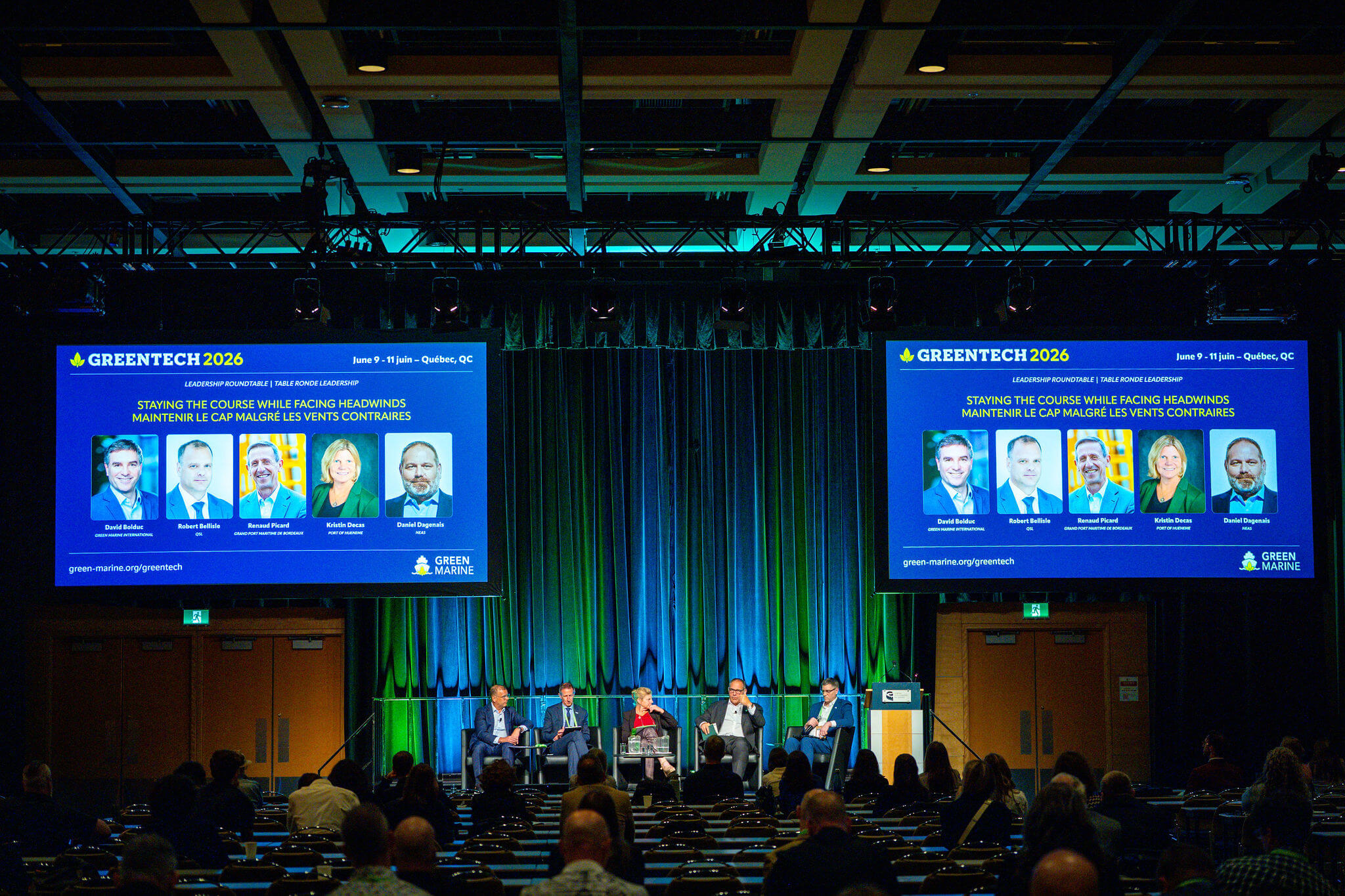
(Photo by Amelieshoots)