
Jury rigged steering systems were fashioned out of rope and wire, lost rudders replaced by hatchboards and spars, anchors carried out by lifeboats lashed together. The crew of a disabled cargo liner would dine out for the rest of their lives on the tale of how they managed to produce a full set of sails using hatch tarpaulins hung from the derricks, to sail half way across the Atlantic. Those were just the headline grabbers; all around the world seafarers on deck and in the engine room, were patiently fixing things when they broke, so that the job could be kept running, and the ship sail.
But in contemporary times, there are very many cautions attached to doing what comes naturally to a seafarer as lawyers, regulators and worst of all, law enforcement, is quick to condemn seafarers who try and fix things, rather than stopping where they are and demanding assistance. There are a lot of hapless engineers rotting in US prisons, after they unwisely took steps to “work around” oily water separators that were just so much non-functioning junk.
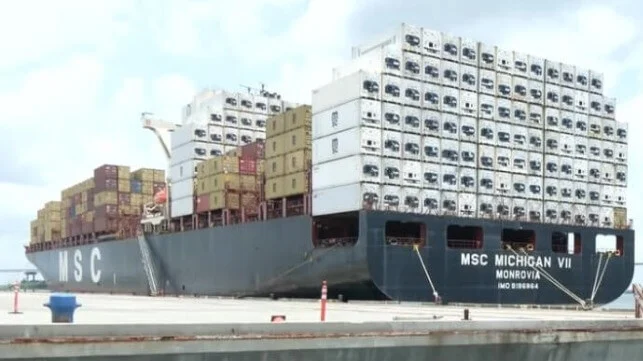
Subsequently, the official attitude assumes the convenient fiction that all equipment must be fully functional at all times and if something breaks, it will be somebody’s fault, with the enforcers scrutinising the circumstances to see if charges can be laid. The laws have been adjusted accordingly. Some people live in a perfect world, but few do so afloat, not that the regulators could ever admit this. These gloomy thoughts resurfaced earlier this month with the case of the unfortunate high-speed dash of the containership MSC Michigan VII, which, it might be recalled went berserk on leaving the Port of Charleston in June 2024, after its engine controls stuck on full speed. As the engineers wrestled with the faulty mechanical linkages below, the bridge team led by the master and pilot managed to weave their way down the Cooper River at 15 knots. The ship had caused all manner of damage to berths and moored craft, including a large bulker being swept from its moorings. The harbour bridge was closed as a precaution, memories of the Baltimore catastrophe being very raw, and the ship was in the roadstead before proper control was established.
We now learn that the chief engineer of the ship has, through the plea-bargaining system beloved of US jurisprudence has admitted his guilt for a string of offences revolving around the maintenance of the vessel, with the governor mechanism and its linkages being worked on as the ship left for sea. Not unreasonably the authorities have concluded that with such known deficiencies, the vessel should have remained safely alongside until they had been fixed.
One can only guess at the sort of pressures they were under to get off the berth, but the ship’s senior engineer looks to pay the penalty, facing five years and a $250,000 fine on one count, and six years and another $250,000 on another. He probably thought he was acting for the best. Meanwhile lawyers for just about everyone who was involved with those lively minutes on the Cooper River are having a field day with the lucrative litigation. We must therefore conclude that “working around” a mechanical problem is no longer a sensible strategy, especially in countries which have somewhat brutal sentencing policies.
One can hardly be aware of the myriad of possible charges that are expanding almost daily by those producing laws and byelaws applicable in their ports around the world. Best to stay safe, risk the wrath of a delay and demand external assistance, even though this does go against the grain. Meanwhile it appears that the UK authorities are about to toughen up the laws and penalties which could descend on anyone who damages undersea cables, with huge fines and lengthy prison sentences for those who have been found responsible. Understandable, of course, as just this sort of interference has become part of the hybrid warfare attributed to the Russian state. It is a message to all to make sure their anchors are well secured and that the bottom trawler skippers are always sure of their positions. Sadly, these are the likely soft targets for these tougher laws, as the malicious parties will rarely face the music and our seas are increasingly criss-crossed by undersea obstructions.
(Screen photo from YouTube of the MSC Michigan V11 docked at the Port of Charleston)
*Michael Grey is former editor of Lloyd’s List. This column is published with the kind permission of The Maritime Advocate.