
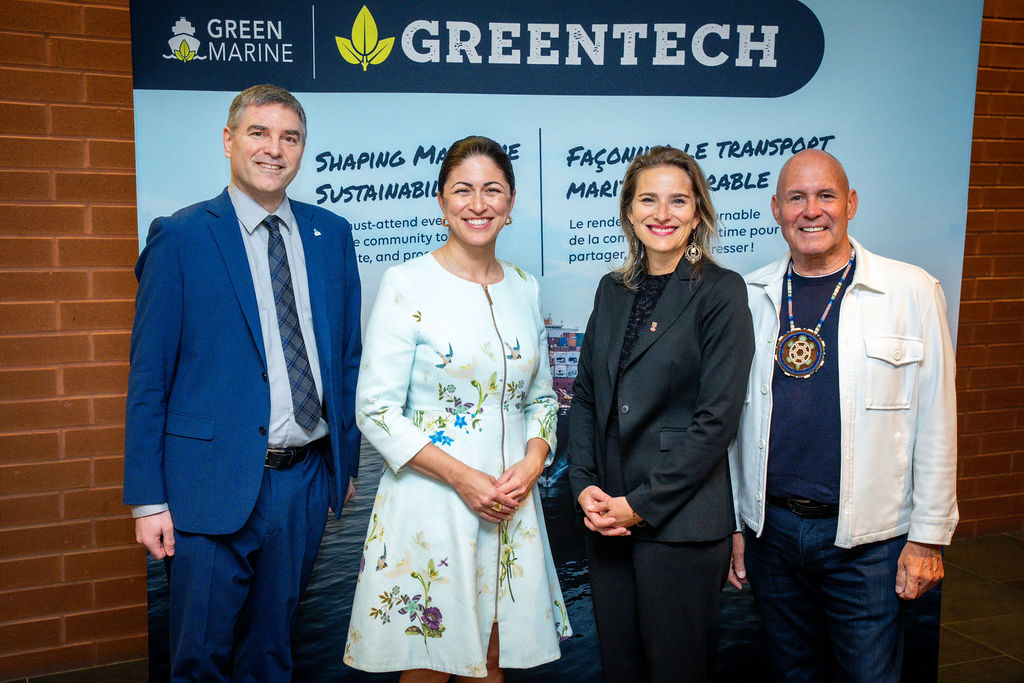
Québec City – Green Marine has welcomed a record 400 delegates to its GreenTech 2026 conference being held in Québec City until June 11th.
“It’s so great to have everyone where Green Marine began 19 years ago,” said David Bolduc, Green Marine International’s President and CEO.
Quebec City’s Deputy Mayor Catherine Vallières-Roland praised the strong attendance. “Your presence demonstrates the growing importance of the issues related to the environmental transition of the maritime sector, as well as to working together to find the solutions,” she said.
The increasing role of the province’s maritime industry in supporting economic resilience was underscored by Alain Sans Cartier, Quebec’s Deputy Minister of International Relations. “Quebec offers a variety of solutions that contribute to making ports greener and more innovative, particularly in the sub-segments of green technologies and optimization,” he added.
Olga Farman, the President and CEO of the Port of Quebec, said that she sensed a greater willingness among ports, governments, First Nations, businesses, research institutes and local communities to collaborate on often complex issues.
The Green Marine framework was credited by Desgagnés Chairman of the Board and CEO Louis-Marie Beaulieu, for providing the framework for steady improvement, noting the shipping firm has achieved the highest Level 5 for all the performance indicators after starting out at Level 2.33 in 2008. “While I’m very proud of this, I’m not saying it to show off, but to demonstrate that progress is possible, and Green Marine definitely helped us on our journey,” he said.
Louis-Marie Beaulieu of Desgagnés underlines environment improvement goals
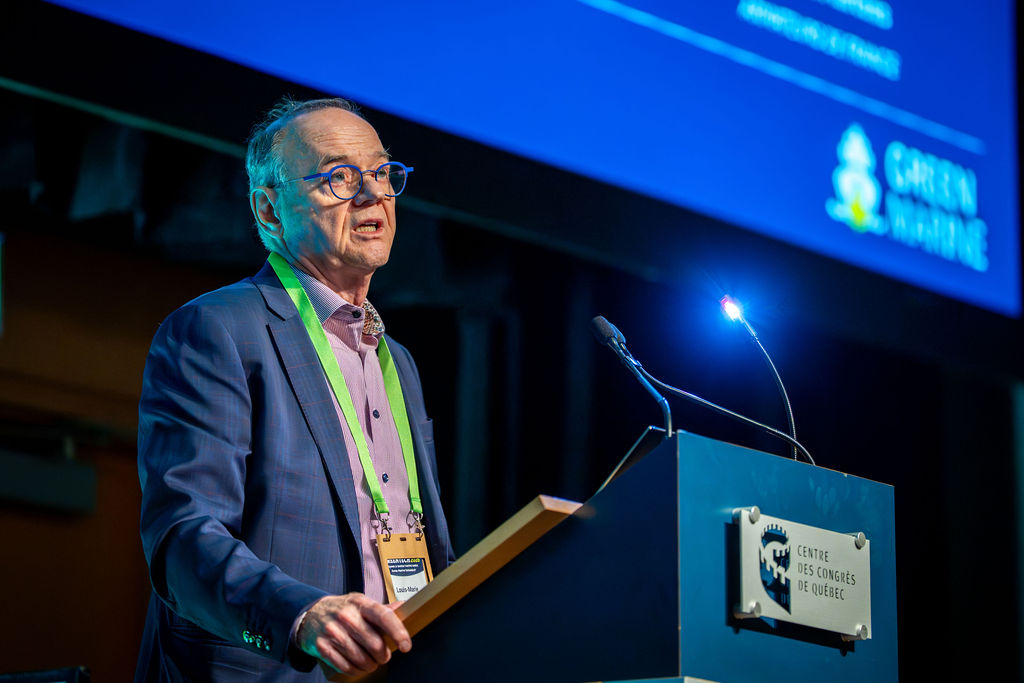
He quickly added that more work needs to be done by Desgagnés and others. “The environment often remains a secondary issue, especially in today’s world,” he said. “I call on everyone to continue efforts to improve the environmental footprint of our industry.”
Stephanie Jones Stebbins, the Managing Director, Maritime at the Port of Seattle, who has just concluded her term as the chair of Green Marine International’s board of directors, praised Green Marine’s practical, science-based approach to setting environmental goals. “These kinds of programs are needed more than ever right now when diplomacy is really falling apart at the international level,” she said. “The diplomacy that we do among ports, shipping companies, terminal operators is so critically important, and will continue our progress until diplomacy at all levels can improve.”
David Naftzger, the Executive Director for the Great Lakes St. Lawrence Governors and Premiers, warned against putting too much emphasis on short-term situations. “I can tell you from a 25-year career working with Great Lakes/St. Lawrence governors and premiers that working through difficult issues with a consensus-building process has proven its value time and again.” He cited the US$300 million now being generated by the Great Lakes and St. Lawrence cruise industry because of collaborative efforts.
Smart money on decarbonization
A session on the future of shipping included Paul Topping, the Senior Director of Regulatory and Environmental Affairs at the Chamber of Marine Commerce, saying the smart money is on ship owners pursuing decarbonization efforts.
“The U.S. has successfully led a blockade to the IMO’s proposed global tax on shipping based on emissions, because it realizes the consumer costs would be significant… and this is the first time that such a tax is being proposed to be paid by an industry rather than governments,” he noted.
“However, a lot of developing countries feel betrayed, as one of the ideas was to use some of this fund to support them, and they are the biggest bloc as the G77 as well as many of the flag states, so they can initiate some pain.”
He anticipated the next major proposal will depend on the extent to which European nations can agree is necessary to dissuade fossil fuel use without being arduous.