
Environmental consultancy Koinon recently released a report concluding that current deep-sea mining projects under consideration run an 83% probability of returning a loss.
Entitled Case Not Proven, The Economics of Deep-Sea Mining, the study drew on the investment prospectus for two projects advanced by Vancouver-based The Metals Company (TMC) that have been under review by the International Seabed Authority.
The study was commissioned by five NGOs and foundations strongly opposed to rapid commercialization of deep-sea mining: Oceans North, Deep Sea Conservation Coalition, Oceano Azul Foundation, the International Union for the Conservation of Nature (IUCN), and Dona Bertarelli Philanthropy.
The question before the International Seabed Authority is whether the commercial exploitation of polymetallic nodules in the Clarion-Clipperton Zone (CCZ) would, on reasonable grounds, generate net financial benefit for the international community and for sponsoring States.
The report tests that proposition against the data submitted by the Proponent for the NORI-Dand TOML areas, stressed for the cost, production, price and governance risks that experience attaches to frontier resource projects. It adopts a conservative approach, limiting the scope and assumptions involved in the stress testing.
“On the evidence, the case for proceeding is not proven,” the report states. “Across the realistic range of outcomes, the activity tends to destroy more public value than it creates. We find this to hold at every material level of production.
“The commercial foundation is weak. On the Proponent’s own engineering assumptions, stressed for known risks, the combined NORI-D and TOML project returns a median net present value of -$5 billion at an 8% discount rate (unlevered), against the Proponent’s stated +$23 billion. Value is negative in 83% of simulated outcomes at that rate, rising toward certainty as the rate is raised to levels the asset class would ordinarily command.
“An internal rate of return (IRR) could not be computed in over 60% of runs; where it could, the median was 4%, against the Proponent’s 27%. The probability that the investment never reaches payback is 61%. The single largest driver of these outcomes is capital-cost overrun, consistent with the established record of megaprojects.”
“In 60% of iterations, the collector’s net cash flow is negative in every year, with the consequence that no internal rate of return exists,” Koinon’s analysts wrote. “Among the minority of runs that do generate a positive return profile, the median IRR stands at 4%.”
The report concludes that the project has an 83 percent probability of returning a loss, with a median net present value of -$5 billion, assuming a discount rate of 8 percent.
By comparison, TMC claims the two projects would make $23 billion and argues that the environmental risks can be managed. The firm argues that the world’s economies need a new source of industrial metals, and that manganese nodule extraction can provide that supply with a lower environmental impact than that of shoreside mining projects.
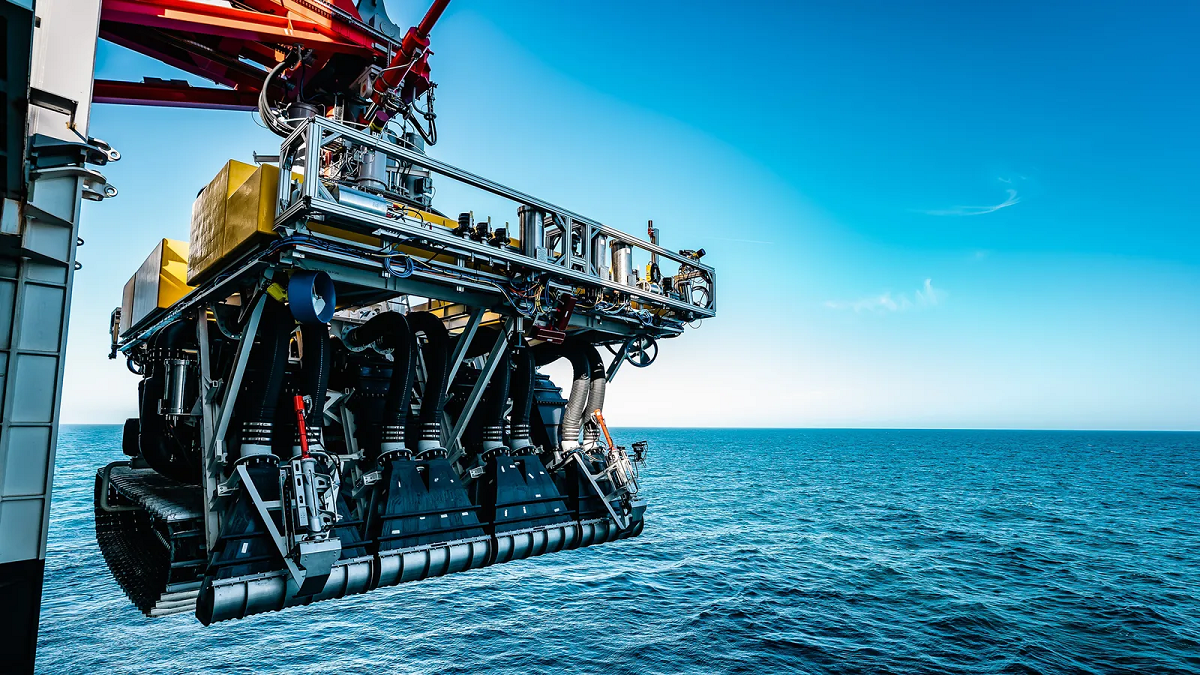
(Photo from The Metals Company)