
By Michael Grey*

For the last 82 years, those making a passage in and out of the River Thames have been aware of the weathered remnants of the Liberty ship Richard Montgomery. Until this month, just three rusted masts marked the resting place of this wreck; something of a conversation piece for those passing, on account of the explosive cargo rotting away in her holds. It was in 1944, with her military cargo bound for the D-Day landings, that the vessel went irretrievably aground on the banks of the estuary, subsequently breaking her back.
Since then, the Richard Montgomery has lived a long life as a source of maritime legend, regularly resurrected by feature writers and editors with blank spaces to fill, as something of a change to tales of the Titanic and the Bermuda Triangle. Although some of the military cargo was salved in the months after her grounding, some 1400 tonnes of high explosives was abandoned in the ship, where it still remains. The official accounts assure everyone that both safety and explosive stability have been regularly checked as the decades have ticked away, with an exclusion zone maintained around the wreck and that the public should not become too alarmed.
This, of course has not prevented exciting journalistic speculation about the cataclysmic events should, by some terrible circumstance, the cargo detonates. The more sensational projections in publications specialising in such outcomes suggest vast structural damage to towns on both banks of the estuary and huge tidal waves sweeping up towards London. It is a useful pot-boiler on a day when little else is happening and the regular correspondents are on vacation.
But is there perhaps more than a tall story in the remains of this short-lived ship? There is no argument about the cargo and its explosive potential, which has remained exceedingly dangerous, despite the passage of years. It is known, from the ordnance that is sometimes inadvertently recovered by aggregate dredgers and fishing craft, that these bombs and shells and other items retain every bit of their initial danger. Single bombs, detonated at sea by the explosive experts explode with a spectacular outcome. It is why explosive berths and anchorages are located miles from built up areas.
The wreck has retained its official hazard rating, while reassuring communiques suggest that if it is simply left alone, everyone will remain safe. For years after the war had ended, ships running up and down the estuary would stop their engines and coast past the location, lest the propeller excited vibrations set off something nasty. Over the years, the practice ceased.
The authorities, despite their efforts to reassure, have always been aware that such a quantity of explosives can detonate with terrifying results. There were enough people around in the early years who might have witnessed the awful results of attacks on explosive laden ships in the convoys.
Also in 1944, although there were efforts to censor the true picture, the Port of Bombay was devastated, when 1417 tonnes of explosives in the lower holds of the Fort Stikine detonated, after her cargo of cotton bales caught fire. There was huge loss of life in the port and city and 12 other ships were either sunk or became CTLs. There were other disasters involving explosive-laden ships elsewhere, including one that did terrible damage to Naples. In peacetime, there is ample regulation to prevent such an incident happening in built-up areas and in all fairness, the wreck in the Thames is reasonably remote.
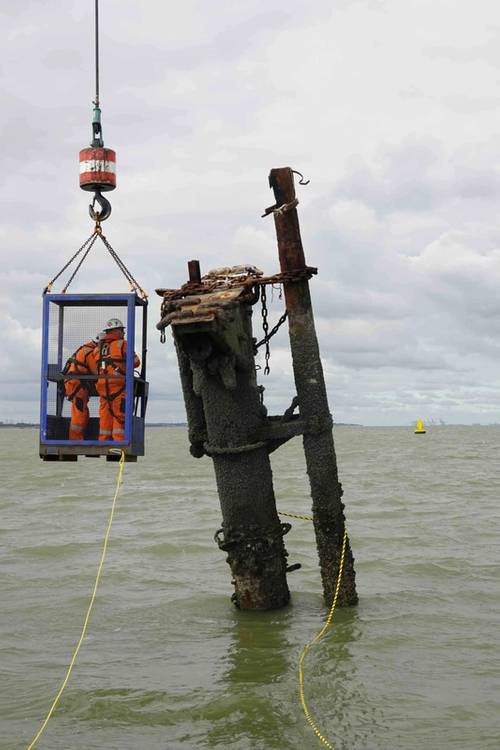
But the Richard Montgomery has been recently in the news because the authorities have decided, that rather than risk the corroded masts collapsing into the wreck, they would be removed. In a delicate operation now happily concluded, the appointed salvors Resolve Marine have taken away this familiar seamark.
The masts will be henceforth exhibited in the excellent Medway Maritime Museum, hopefully with supporting explanations. The hazard, and the deteriorating wreck ,(along with the potential for some imaginative journalism) of course remains, as does the monitored exclusion zone. The visible evidence of this old maritime mishap, and presumably the associated conversations, will be fading memories. Nothing to see here, move on!
(Photo from Resolve Marine)
* Michael Grey is former editor of Lloyd’s List. This column is published with the kind permission of The Maritime Advocate.