
The risk of port congestion and associated delays is affecting all shipping lines and shippers. In week 32 (early August), typhoons in China resulted in ships waiting on average 3.6 days for a berth, according to Drewry’s Ports and Terminals Insight.
It is not just a short-term weather-related issue. The global average for ship waiting times has nearly doubled between the first 7 months of 2019 and the first 7 months of this year. Both ship waiting times and total port call durations have increased since 2019, but a larger share of a vessel’s time in port is being spent waiting for a berth rather than being handled at the terminal, pointing to congestion pressures before arrival alongside. Waiting for a berth contributed to the 31% jump in average time spent by a containership in a port between 2019 and this year, with significant variations by region.
So, containerships are demonstrably less productive in ports and spend more time waiting for a berth than they were before the Covid pandemic.
In a company’s financial presentation on 13 August, Vincent Clerc, CEO of A.P. Moller-Maersk, said that container port capacity is insufficient and causing congestion in several regions, including Europe, the East Coast of South America, West Africa and the Middle East, in a context of strong container export growth from Asia. “This growth and increasing trade imbalances comes on the heels of about 15 years since the financial crisis, where investment into terminal capacity has lagged,” he said.
But Drewry’s view is that the higher risk of port congestion is linked to several industry trends and constraints, some of which are outside the control of port operators. Here are some of the key factors:
A terminal running at 90% berth utilisation takes roughly one week to recover from a one-day disruption. A terminal running at 75% utilisation can recover in two days. The difference between those two operating points, in normal years, could be the difference between a competitive and an uncompetitive return on capital, Drewry port consultants said.
Drewry would also argue that ocean carriers follow the same primary objective as terminal operators: focus on costs and on returns, not on supply chain resilience. Carrier strategies to maximise returns such as blank sailings, ad hoc sailings and extra loaders can result in high peaking factors at major ports, which is a major contributor to yard congestion or waiting time at ports.
Drewry’s analysis of port capacity, port throughputs and port utilisation from our global databases show that, based on 9 major container ports, terminal operators on average expanded capacity by 21% between 2019 and 2026, below the growth of 28% in volumes during the same period. Singapore expanded its port capacity slightly faster than volume, whereas Shanghai, Santos, Jawaharlal Nehru Port and Qingdao did not.
Drewry conclusion
The risk of port congestion is increasing. However, terminal operators in most regions are not failing to invest and will continue to invest in port capacity, although ultimately they cannot finance “buffer capacity” on their own. The container shipping ecosystem is currently built to optimise cost – not resilience.
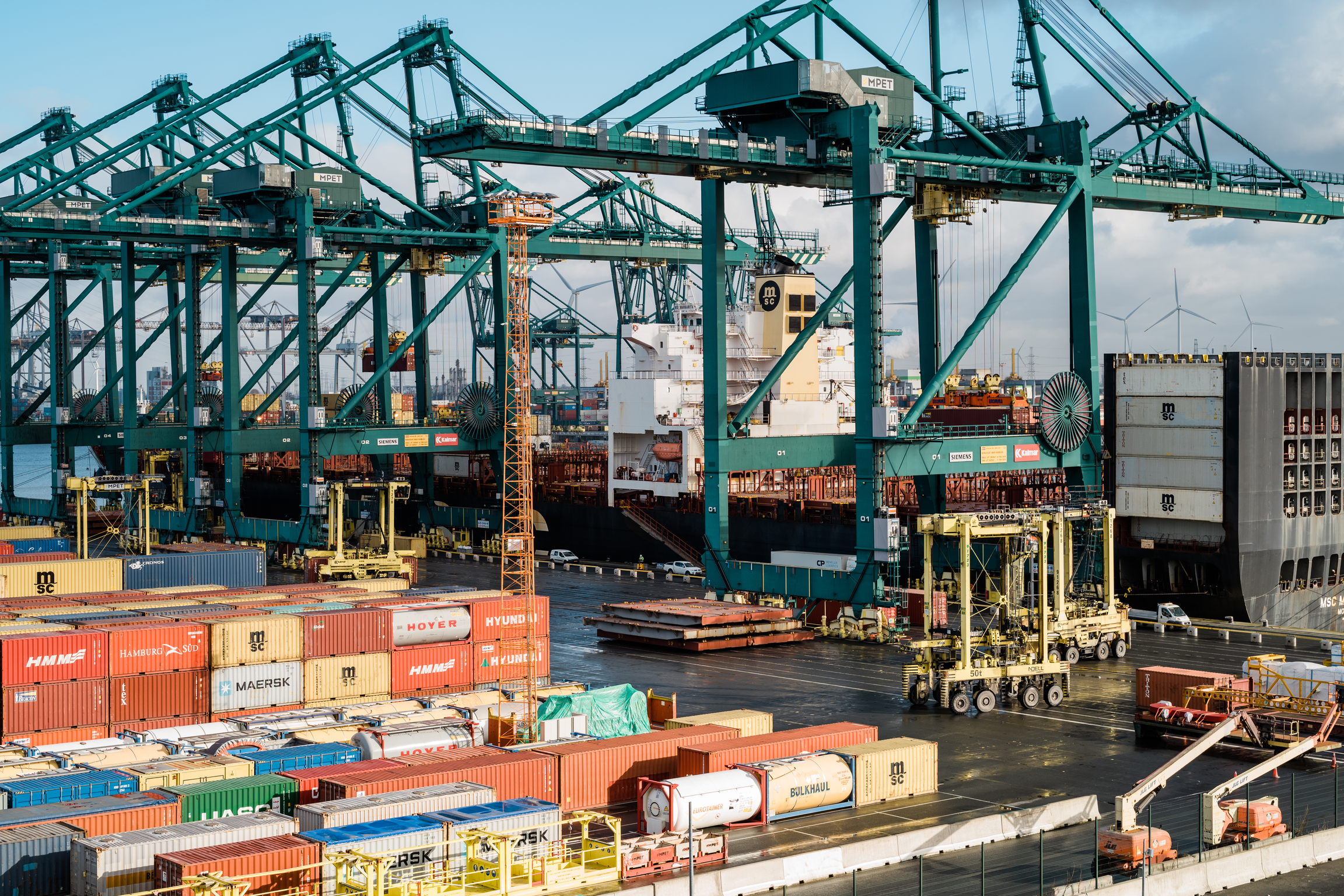
(Port of Antwerp photo)