
By Michael Grey*

The United States has often been accused (quite unfairly as most other developed nations are as bad) of being the archetypal throwaway society. And while it might be the case with consumer goods, in the maritime world, the US seems to treasure their old ships and cannot bear to part with them.
In every creek on every coast you will find rafted up great fleets of « reserve » ships, in every conceivable state of readiness, should there be a sudden demand for their services. Some await only a crew and some stores and fuel to awaken them, but many others will, realistically, be most unlikely to ever operate again. But you might think that to keep them afloat requires a mind-set of admirable preparedness, maintaining this vast tonnage, just in case it might be needed.
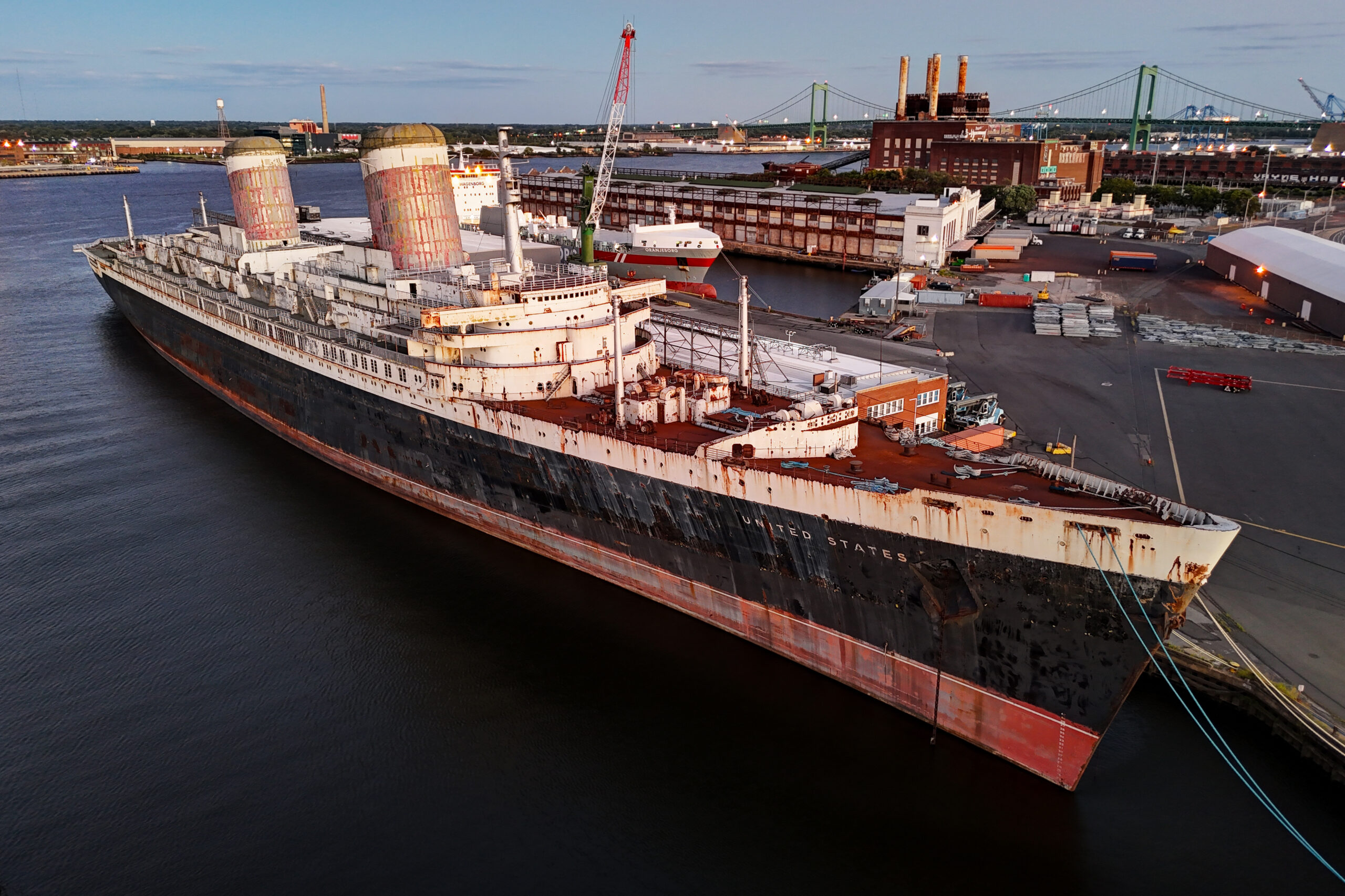
These thoughts arose from the very last voyage of the old North Atlantic greyhound SS United States, which was finally sunk as a cross between a monument and a marine habitat last week. Various bits of the old ship, such as the two gigantic funnels and her iconic mast, have been retained ashore and will doubtless prove interesting exhibits in maritime museums. (The historic liner was sunk off the coast of Florida, and was transformed in the world’s largest artificial reef.)
She now rests on the bottom, sufficiently deep not to be a hazard, the right way up, which is no small feat in a controlled sinking of such a big hull, her upperworks soon to delight recreational divers.
A technical tour de force when she entered service in 1952, the United States was built for speed and has remained the holder of the Blue Riband trophy to this day, despite various spurious claims by speedboats and fast ferries. Her speed was a closely guarded secret, with the great liner’s auxiliary role as a troop transport, although her thirst, and the dread effects of mass air transport, were ultimately to see her career as a liner, prematurely terminated.
But decades passed, while the old ship, still officially a reserve unit, remained laid up, with the government finally relinquishing any interest in the ship. She then passed into the realms of historical preservation, with various schemes, one involving a transatlantic tow to rid the ship of asbestos, coming and going. For the past thirty years, she mouldered away in the Port of Philadelphia, as the various preservation parties have suggested ideas which have all foundered on the rocky reef of realism and costs. The port finally lost patience, and after a lot of arguments, in which the supposed indignities of demolition were ranged against the manifold attractions of sinking, the final chapter was written.
Another historic ship was in the news this month, with the last voyage, also under tow, of the US aircraft carrier Enterprise, which was the first of the giant nuclear ships designed for both power projection and a long life. She was first commissioned in 1961 and remained in operation for the USN for more than half a century. Dismantling such a ship is no easy matter, with her battery of nuclear reactors and it has been reported that the contract to recycle the « Big E » will cost some $418m, which give or take an air wing or two, was probably almost as much as she cost new.
With a huge increase in the number of ships which, once the current boom wanes and the vast number ordered arrive on the market, will require recycling, one might think that demolition will globally surge. But true to form, the EU Parliament Environment Committee has refused to add a couple of highly capable Indian shipbreaking yards to the « approved » list, despite their heavy investment in safety and environmental compliance to Hong Kong Convention standards.
The usual suspects are to blame, with the energetic lobbying of the NGO Shipbreaking Platform to the fore, urging rejection on account of the technique of beaching still employed by the Indian yards. But once the wave breaks and the demand for recycling surges, it will be interesting to see if the European stance holds.
Finally, in this catalogue of curiosities, it might be recalled that it was the proud boast of the designers of the United States that the only flammable object aboard was the butcher’s block in the galley. In the early 1950’s big passenger ships tended to burn rather a lot. One hopes this artefact has been recovered, but the very day this all-metal ship was towed away to sea, scientists at the German Aerospace Centre suggested that a useful lightweight material for fireproof divisions aboard cruise ships was …wood, albeit of a special fireproof composition. Amazing how things come around.
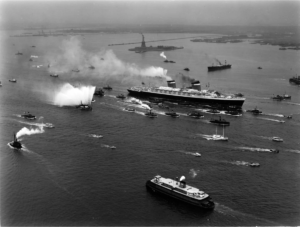
(Historic photo of SS United States from ssusc.org and decommissioned vessel in Port of Philadelphia by Dreamstime)
*Michael Grey is former editor of Lloyd’s List. This column is published with the kind permission of The Maritime Advocate.