
By Leo Ryan, Editor
Within a few hours after the Supreme Court ruled that Donald Trump had overstepped his authority by imposing sweeping global tariffs on so-called Liberation Day last April, an angry U.S. President announced a global tariff of 10% for 150 days to replace some of his “emergency” levies. He said the new duties would be over and above the existing tariffs.
In a 6-3 ruling, the Supreme Court said that the International Emergency Economic Powers Act (IEEPA) does not give the president the power to impose what Mr. Trump called “reciprocal” tariffs varying between 10% and 50%.
Due to the Canada United States Mexico Trade Agreement (CUSMA), Canada is exempt from the global tariffs, but heavy sectoral tariffs on steel, aluminum, lumber and automobiles – which have had a big impact on the Canadian economy – remain in place. The negative impact has been especially significant in key port/cities on the Great Lakes.
In his hastily-arranged press conference, Mr. Trump spent a lot of time name-calling the three of six conservative justices who sided with three liberal counterparts in the final ruling. He qualified the decision as “terrible,” “unpatriotic,” and said the concurring justices were “disloyal to our nation.” He further claimed that the court had been swayed by unnamed “foreign interests,” and that some justices are scared of such interests.
In addition, he maintained that his tariffs have ended multiple wars and that they’ve improved national security.
He reiterated his determination to “protect our country from unfair trading practices.”
Among initial reactions in Canada, RBC economists Claire Fan and Nathan Janzen stressed Canada’s real priority is protecting exemptions under CUSMA.
Compared to the U.S.’s other trading partners (including Mexico, the U.K., South Korea, Japan and China), Canada was the least exposed to the IEEPA tariffs, according to data compiled by RBC.
In fact, the economists wrote, “89 [per cent] of Canadian exports to the U.S. in December were not charged with tariffs because they’re compliant with rules of origin requirements in CUSMA.”
At the time of writing, it was unclear whether CUSMA-compliant goods will be exempt from Trump’s new global tariff. Also there was no immediate comment from Prime Minister Mark Carney.
Dan Kelly, President, Canadian Federation of Independent Business (CFIB), said the Supreme Court ruling was a welcome development for small businesses on both sides of the Canada/U.S. border.
”But while this decision weakens the administration’s justification for tariffs, it is likely that other tariff and trade tools may be used to accomplish the same end,” Mr. Kelly said in a prediction that was rapidly confirmed by Mr. Trump.
In a similar vein, the president of the Canadian Chamber of Commerce said earlier Friday that the ruling is “not the last chapter of this never-ending story.”
“Canada should prepare now for new, blunter mechanisms to be used to reassert trade pressure, potentially with broader and more disruptive effects,” chamber President and CEO Candace Laing said in a media statement just prior to new measures announced by President Trump.
What’s next?
The Supreme Court ruling is likely to lead to a chain reaction of legislation and administrative actions involving the Trump administration, US Customs and Border Protection, US importers, and trade consultants and attorneys representing those importers, reported the joc.com news platform.
CBP will have to refund importers hundreds of billions of dollars of tariffs paid over the course of the last nine months, though the Supreme Court’s decision Friday did not specify how that process should take place.
Pete Mento, director of global trade advisory services at accounting firm Baker Tilly, told the Journal of Commerce that the Court of International Trade will decide how the refund process will unfold, a decision he said will likely come quickly.
In early January, CBP shared a new electronic refund process that trade experts saw as a foreshadowing of Friday’s decision.
“The court said tariffs are taxes, taxes belong to Congress, and ‘regulating importation’ in a sanctions statue does not secretly mean ‘rewrite the HTS because the trade deficit hurt your feelings,’” Mr. Mento wrote in a LinkedIn post Friday.
The calls for refunds are coming fast. The National Retail Federation praised the Supreme Court’s decision and urged lower courts to “ensure a seamless process to refund the tariffs to US importers.”
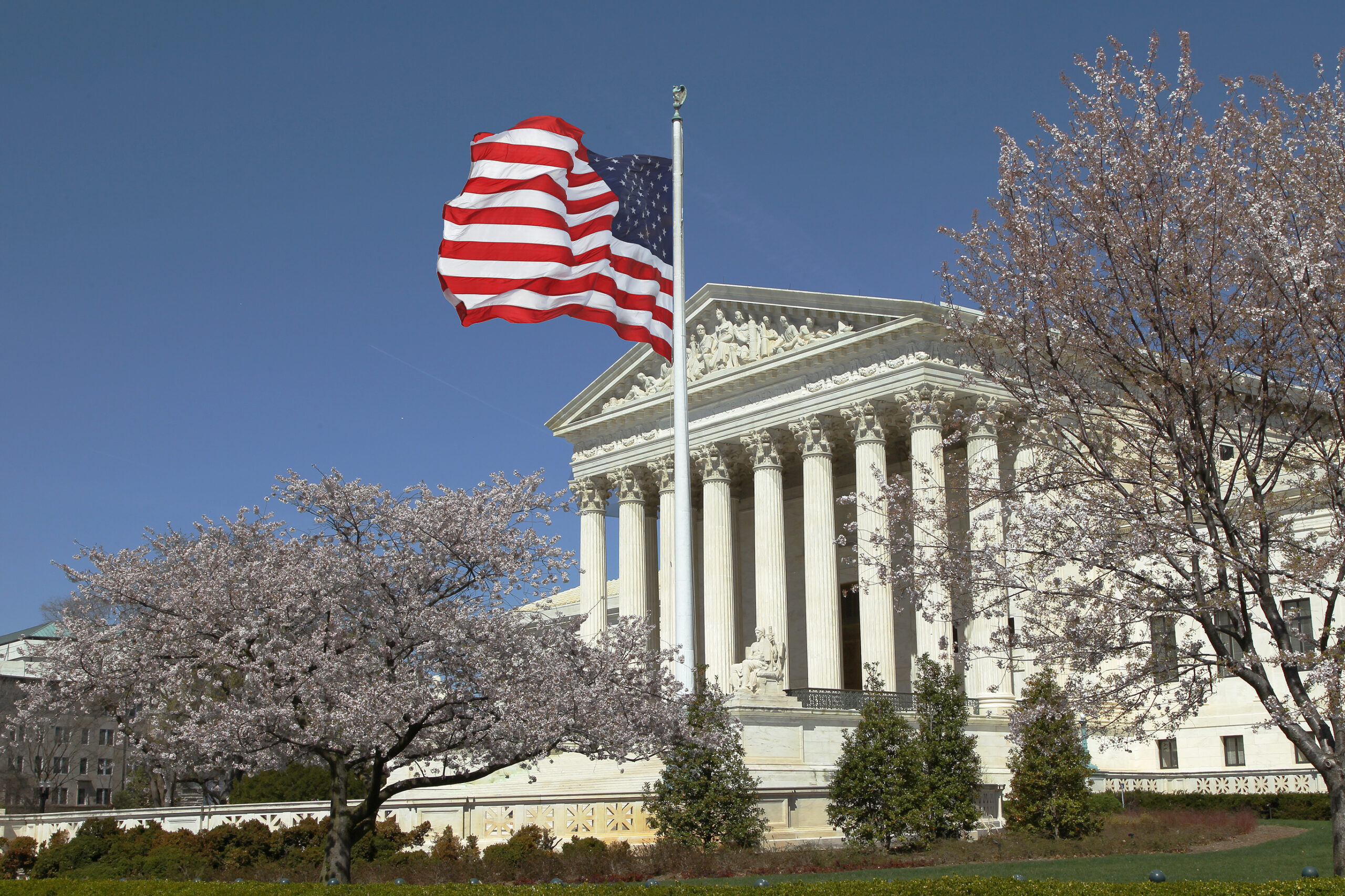
(Dreamstime photo of US Supreme Court)