
By Julie Gedeon
The St. Lawrence Ship Operators (Armateurs du Saint-Laurent) welcomed key industry stakeholders to its March 21st luncheon-conference at the Saint-James Club in Montreal to assess the future of shortsea shipping.
“Our supply chains have been shaken by geopolitical developments, shifts in trade patterns, and growing pressure on land-based networks,” Saul Polo, the association’s President and CEO, began. “Shortsea shipping offers an incredible response to several challenges: it can ease road congestion, reduce emissions, and strengthen logistics resilience for Quebec and Canada.”
He said these advantages require government backing. “The current framework still too often favours road transportation and in some cases rail,” he stated. “Take, for example, the federal government’s decision to cut rail freight rates by 50% for interprovincial shipments of Canadian steel and lumber, while leaving Canadian maritime transport high and dry.”
Mario Lefebvre, an Aviseo partner and the Bank of Canada’s former Quebec regional director, said opportunities exists with 2026 global economic growth pegged at 3% prior to the Iran conflict. “We must invest significantly – even in an uncertain economic climate – if we want to turn the economy around from the dramatic change in our U.S. trading relationship,” he affirmed.
François Marier, Transport Canada’s International Marine Policy Director, concurred. “The government has been clear that its objective is to create one united economy and reduce reliance on a single trading partner and that includes diversifying Canada’s trade,” he said. “To achieve that, Canada’s maritime sector needs to be forward-looking and transformative.”
He said trade diversification will likely be led by exporting larger, heavier products requiring new infrastructure, and rising bulk exports of grain, agri-foods, metals and manufactured goods is increasing pressure for outbound container services.
Mr. Marier noted the newly announced $5 billion Trade Diversification Corridors Fund to improve critical transportation infrastructure, address congestion, and improve regional connections, as well as a $1billion Arctic Infrastructure Fund for dual commercial-military purposes. He also mentioned Ottawa’s $130 million in support for the Contrecoeur Terminal expansion in Montreal, and $163.8 million for projects at the Bécancour Port and Industrial Park.
Serge Le Guellec, Desgagnés Interim President, said the industry was moving in the right direction but more needs to be done. “We must act upon identified opportunities that make the most of intermodal possibilities,” he said, adding that each province’s maritime organizations are still operating somewhat in a silo instead of dovetailing efforts. “We’re still lacking a real national strategy that builds connected intramodality throughout Ontario, Quebec and the Atlantic region.”
He noted the need to ensure labour is ready to handle opportunities, as well as to call upon the expertise of existing innovation hubs to investigate the feasibility of new technologies such as autonomous vessels.
Scott Bravener evokes European-style incentives
Scott Bravener, McKeil Marine’s President and CEO, suggested government could assist in the “risk absorption phase” by providing incentives to encourage shortsea shipping for societal benefits. He noted the European Union is requiring 30% of all trucking journeys over 300 kilometres to be diverted to shortsea shipping by 2030.
“Our government can play a role in supporting capital investments in port infrastructure, cargo handling, automation and, in particular, ice breaking,” he said. “If we’re going to make shortsea shipping happen, we can’t have the Seaway operating nine months.”
He stressed the need to identify shippers who prioritize reliable service over simply pricing with all intermodal stakeholders collaborating to provide them with ideal solutions. “We’re not trying to get rid of trucks,” he said. “Just the inefficient part of their journey.”
He suggested ports remain the weakest link. “We have some fabulous ports, but they’re outdated, lacking automation,” he said, pointing to Europe having dedicated shortsea shipping facilities.” “For shortsea shipping to be successful, it has to be a high-level 24/7 operation, with a different quick turnaround service model now that we’re transferring cargo inland.”
He said the Seaway operating at 50% capacity isn’t due to a vessel shortage but a lack of productivity and predictability. “I know the Seaway can’t operate 365 days – it needs a maintenance period – but if we can stay open for 11 months, shippers would adjust,” he said.
“And if we’re looking at containerization, we need the infrastructure in place to do it properly,” he said. “It can’t be piecemeal.”
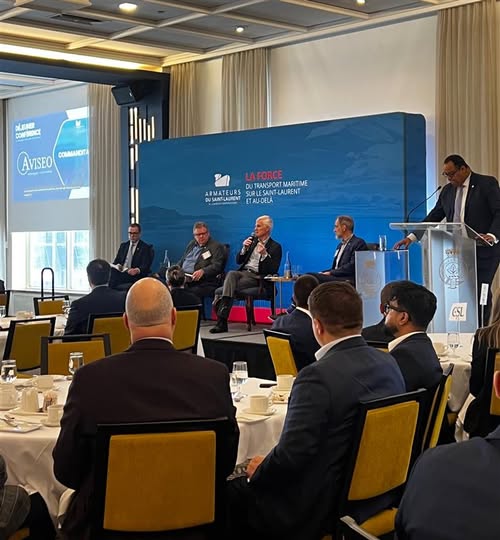
(Photo left to right): Louis-Philippe Allard, CargoM’s executive director, Capt. Scott Bravener, McKeil Marine’s president & CEO, Serge Le Guellec, Desgagnés’ Interim President & General Manager; Shawn McMahon, DP World’s Supply Chain Strategy director, and Saul Polo, St. Lawrence Ship Operators President & CEO)