
SIU Canada President Chris Given has sent a letter to a wide range of marine sector stakeholders across the country, including government officials, companies, industry partners and other labour organizations regarding a proposal currently being considered as part of a Transport Canada consultation. If implemented, the proposal would permit foreign-flagged vessels to operate in Canada’s domestic shipping trade during so called “emergencies” without a coasting trade license, says the Letter dated May 27 from the Seafarers’ International Union of Canada.
The consultation, Strengthening One Canadian Economy through trade and transportation, opened on May 8th, 2026, requests that stakeholders provide input on a number of proposals put forward in the corresponding discussion paper.
Mr. Given draws attention specifically to a proposal found in the section entitled Reduce Red Tape and Streamline Regulations in which “the Government has casually proposed to consider legislative change that directly attacks Canada’s domestic shipping sector and Canadian mariners.”
The section provides for “targeted flexibility during emergencies, including allowing foreign vessels to temporarily operate without a coasting trade licence to support critical supply chains.”
The Letter states: “As you are aware, all activities related to coasting trade in Canada are reserved for Canadian-flagged vessels, predominantly employing Canadian and permanent resident seafarers. Under our current regulations, a foreign registered vessel may already be imported for use in coasting trade for a period of up to one year upon successful application to the Canadian Transportation Agency.
“Under the existing system, there is already a “fast track” and “emergency” process by which a foreign vessel can be imported for use in coasting trade in as short of period as 2 days should there be no objection or offer of a suitable alternative ship from a Canadian shipowner. Put simply, the proposal to waive the requirement to obtain a coasting trade licence is entirely unnecessary and appears to be designed to prevent Canadian operators from being able to object to the importation of a foreign vessel.”
Protecting Canadian sovereignty
The Letter further alleges: “This proposal is a complete contradiction of this government’s supposed priority of ensuring that Canada remains a self-sufficient country, that we remain a sovereign nation and that we retain autonomy over our supply chains, including in our ability to move both goods and people on nationally owned and operated ships, crewed by a qualified domestic maritime workforce. What FOC (Flag of Convenience) flag state does this government believe will come to our aid in a crisis? What nationality seafarers will put themselves at risk to ensure our supply chains remain intact? Which foreign Company will agree to provide reliable service at a fair price? The reality is that almost every other nation of the world is moving in the opposite direction.”
“While our government is considering opening our cabotage to foreign operators, the rest of the world is implementing the lessons learned from the pandemic and recent wars – we must be self-sufficient in the face of a crisis,” the Letter affirmed.
In this connection, the Letter referred to recent initiatives in Australia, Norway, and Brazil. In addition, it noted: “NATO and allied nations are currently focusing on the ability to address tonnage and workforce needs in times of conflict, addressing the issue of “sea blindness” or the neglect of consideration for the importance of waterborne transportation capability in a conflict – this is grounded in the promotion of cabotage and the need for national maritime policies to promote and develop civilian mariners and sealift capabilities to augment forces’ capabilities in times of need.”
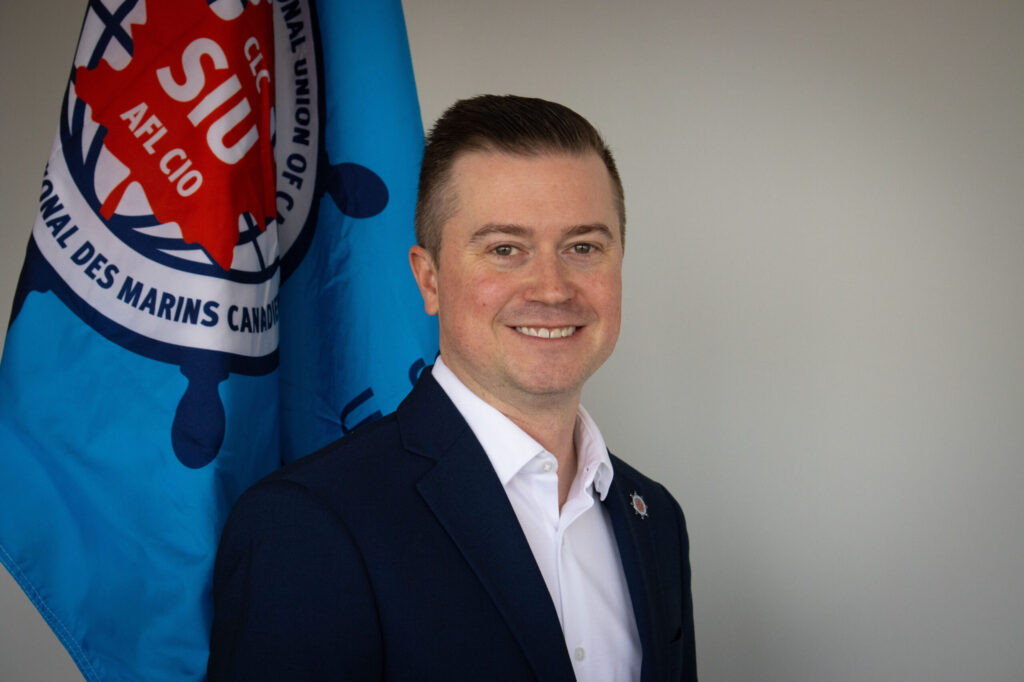
(SIU Canada photo of Chris Given)