
Lloyd’s Register Maritime Decarbonisation Hub (The Decarb Hub) has called for a standardised approach to the design and assessment of Safe Havens on ammonia-fuelled vessels, highlighting that inconsistent interpretations of emerging regulatory requirements could result in differing safety outcomes across the future ammonia fleet.
This is set out in a new report, ‘Safe Havens for ammonia-fuelled ships‘, which examines how the maritime sector can apply lessons from offshore oil and gas, chemical processing and other safety-critical industries to address a new requirement introduced under the International Maritime Organization’s (IMO) Interim Guidelines for the Safety of Ships using Ammonia as Fuel (MSC.1/Circ.1687). The new guidelines now require vessels to incorporate Safe Havens to protect crew in the event of an ammonia release.
However, the report highlights that, as is often the case with interim, goal-based guidance for a new safety concept, the guidelines set high-level requirements that leave room for differing interpretations of what makes an effective Safe Haven. It proposes a shared framework to help vessel designers, operators, classification societies and flag administrations apply these requirements consistently as ammonia-fuelled vessels enter service.
The Decarb’s Hub research found that Safe Havens should not be viewed as standalone spaces designed solely to prevent ammonia exposure. Instead, they should be treated as human-centred systems that form part of a vessel’s wider emergency response strategy.
The report identifies three core functions that every maritime Safe Haven should provide: protection, command and control, and accessibility. Together they are intended to ensure that all crew remain protected from ammonia and other hazards, while enabling the execution of the vessel’s emergency response plan.
Drawing on established practices from industries that routinely manage toxic gas hazards, the report recommends that Safe Haven performance is assessed against realistic worst-case scenarios. It also highlights the importance of calculating Safe Haven endurance periods, assessing accessibility, regular testing and maintenance and human factors considerations to ensure systems continue to perform as intended throughout a vessel’s operational life.
The report concludes that the industry should focus on developing standardised methods for demonstrating Safe Haven performance. Establishing a consistent basis for assessment will help ensure Safe Havens deliver the intended level of protection across the future ammonia-fuelled fleet while supporting regulatory certainty and long-term operational confidence.
Jonathan Bolton, Decarbonisation Risk Analyst at the Lloyd’s Register Maritime Decarbonisation Hub, said: “Ammonia has the potential to play an important role in shipping’s decarbonisation journey, but its adoption must be supported by safety solutions that are robust, practical and consistently applied. Safe Havens are a new requirement for ammonia-fuelled ships and as with any new safety concept, the industry needs practical guidance to build a shared understanding of how Safe Havens should be designed and assessed.”
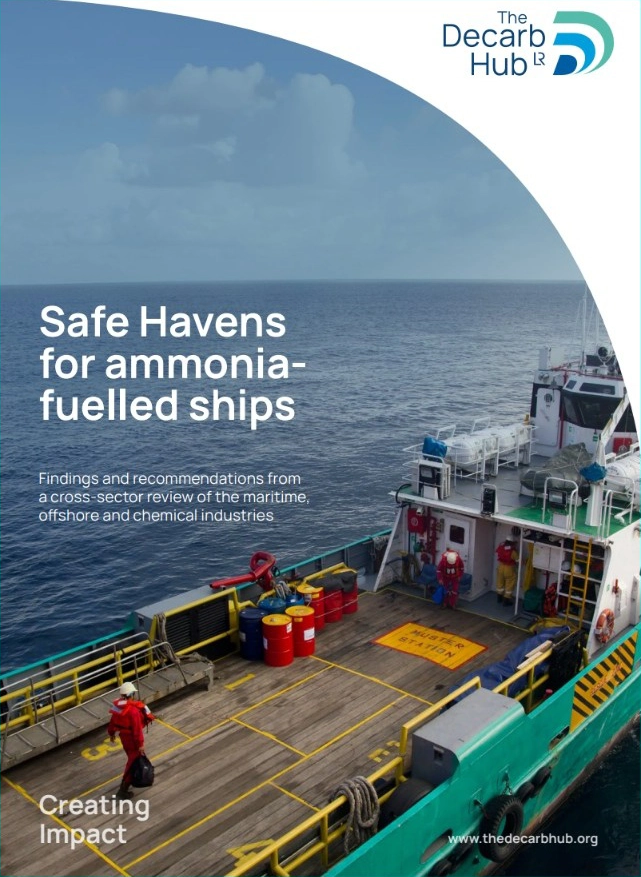
(Report image from Lloyd’s Register)