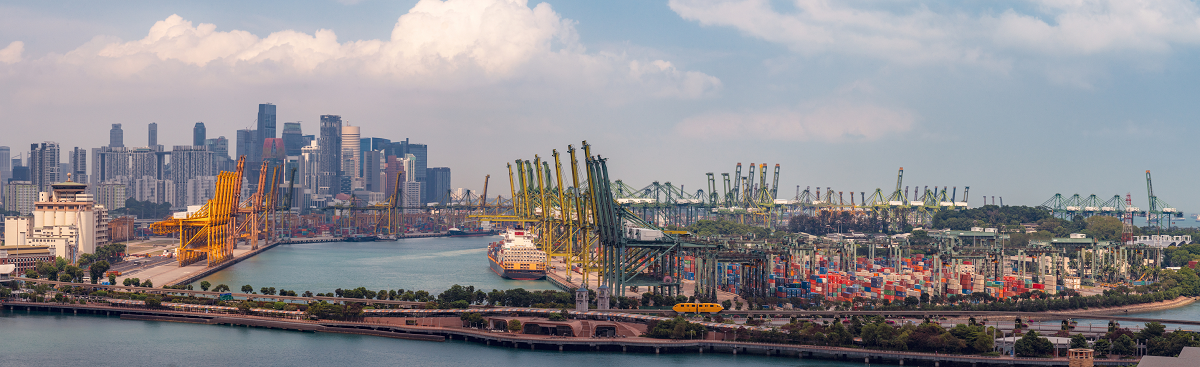
Singapore holds onto its position as the world’s leading maritime city in the just-released 2026 Leading Maritime Cities (LMC) report from DNV and Menon Economics. Asia now accounts for three of the world’s top five maritime cities. Singapore is followed by Shanghai, London, Rotterdam and Tokyo.
Singapore has held the top position since the report was first published in 2015, through a combination of shipping activity, port infrastructure, maritime services and investment in technology. Shanghai produced the biggest shift in the rankings, climbing from fourth to second place, overtaking both Rotterdam and London. Tokyo returned to the top five, surpassing Oslo, which ranked fifth in 2024.
The latest rankings also saw ports in North America lose ground. New York remained the region’s highest-ranked city but slipped from sixth to eighth place while Houston fell five positions to 20th, and Los Angeles dropped from 19th to 25th.
Vancouver steep decline
Vancouver, Canada’s largest port, recorded an even steeper decline, falling from 13th to 28th place.
“This has been a year of disruption and adjustment for the maritime industry,” said Cristina Saenz de Santa Maria, CEO Maritime at DNV. “Faced with these challenges, the leading maritime cities have demonstrated that leadership is built not on a single activity, but on breadth.”
Dr Shahrin Osman, Global Business Development Leader, Maritime Advisory and co-author of the report, said: “Over time, the LMC has evolved from benchmarking where maritime activity is concentrated to assessing which cities are best positioned to combine maritime scale with capacity to adapt to changing industry conditions. Across the five pillars, the results show that there is no single model for maritime leadership. Cities compete from different positions, and their strengths reflect the role they play in the global maritime industry. Those that come out on top link infrastructure, commercial decision-making, specialist services, technology and talent into a single working cluster.”
Now in its seventh edition, the study initially assessed more than 15,000 cities using objective maritime indicators to identify 50 candidates for the final ranking. These cities were then benchmarked using 48 objective and subjective indicators across five pillars. The assessment incorporates responses from more than 200 maritime industry experts globally.
The 2026 edition introduces new and updated indicators to reflect changes in the maritime industry and the factors shaping the competitiveness of maritime cities, including the energy transition, technology, talent and resilience. As the framework has evolved, changes in rankings compared with previous editions should be considered in the context of these methodological updates.
(Dreamstime photo of Singapore port city)