
Chris Hall
By Leo Ryan, Editor
Current severe disruptions to the global trade and shipping environment ranging from the Persian Gulf conflict to the tariff war ignited by the Trump Administration were front and centre on the agenda of the 2026 annual conference of The Shipping Federation of Canada. The overall theme was the Outlook for international shipping and the challenges and opportunities shaping global trade.
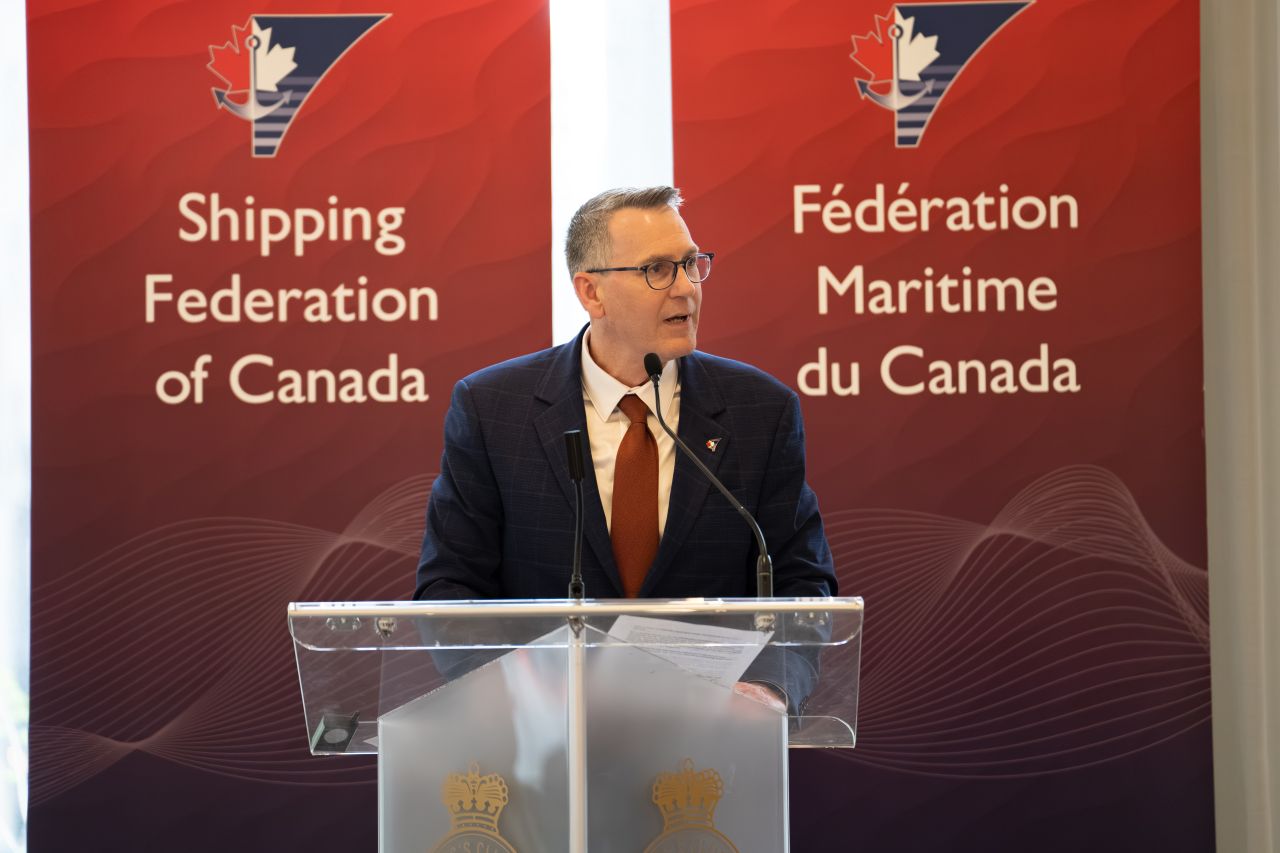
Also highlighting the event on May 14 was the unveiling by President and CEO Chris Hall of an unprecedented comprehensive study nearing completion on the values and volumes of Canada’s main export and import commodities carried by international ships.
Kicking off the business sessions was Pascal Chan, VP Strategic Policy and Supply Chains at the Canadian Chamber of Commerce, whose presentation was titled The Big Picture: Trade, Tariffs and Politics.
Both domestically and internationally, he observed, “a lot of things are falling out of our control.” Internationally, following the Russian war on Ukraine, there is now the Middle East crisis.
On the domestic front, he expressed the Chamber’s concern over the series of strikes in recent years that have hit Canada’s railways, ports and St. Lawrence Seaway. “All these things are damaging to Canada’s reputation as a trading nation,” he warned before stressing the need to portray Canada as a country of “industrial peace.”
At the same time, at present, “Canadian and U.S. prosperity are at risk in the shadow of new (Trump) tariffs.”
Within the overall context, Mr. Chan affirmed Canada must strengthen its economic competitiveness by modernizing its transportation infrastructure, reducing internal trade barriers and pursuing a trade diversification strategy lessening heavy reliance on the United States. The latter includes expanding trade with Europe and Asia, but the Chamber feels greater attention should also be paid to identifying more foreign market opportunities for specific Canadian goods and commodities.
Lars Jensen on navigating the shipping storm
Offering a liner shipping perspective in today’s fast-evolving and unpredictable geopolitical landscape, notably in the Middle East, was consultant Lar Jensen of Vespucci Maritime.
As he spoke, the US-Iraq conflict was in its third month. The Strait of Hormuz was closed to shipping. One of the world’s most critical maritime chokepoint carries around a quarter of global seaborne oil trade and significant volumes of liquefied natural gas and fertilizers.
In the highly-complex situation, Mr. Jensen felt that “only a diplomatic solution” could reopen the Strait of Hormoz.
Past history, he noted, offered harsh lessons of the challenges involved. In this regard, he recalled the so-called “Tanker War” which occurred between 1981 and 1988 as a naval extension of the Iran-Iraq war. (Some 600 vessels were attacked by both sides in the Persian Gulf and Strait of Hormuz to weaken each other’s economies.)
Considerable uncertainty driven by supply chain disruptions, trade disputes and geopolitical tensions was putting pressure on the international shipping industry to show exceptional resilience, Mr. Jensen said.
Touching on the outlook for container shipping markets, Mr. Jensen said: “In terms of global demand, the world is doing fine” – although the imbalance in both directions on various trade lanes is changing the trade set for global shipping lines.
Turning to emerging shipping trade trends to watch, Mr. Jensen foresaw Africa as the growth market of the future.
“It is a trade that goes between the Far East, the Middle East and Africa. That is where companies are focussing on driving new markets and improving their bottom lines,” Mr. Jensen said. He acknowledged that the African continent still has major infrastructure requirements – “but that will come.”
Leveraging international shipping’s role through advocacy
Sara Colborne, Senior Advisor of the Sandstone Group, stressed the benefits of “making advocacy work” through effective government relations to reinforce Canada’s trade agenda and maximize the role of international shipping in economic growth.
“Get the data,” she urged, while singling out strong data among the important components needed in effective advocacy and clear messaging.
Federation study on international cargo flows
At the conclusion of the business session, under the theme of Closing the data gap, Chris Hall presented a brief overview of the Federation’s Trade Analysis of Canada’s International Cargo flows.
After underlining how the access to accurate data was essential to efficiently assess trade and transportation perspectives, Mr. Hall indicated the study was “the first comprehensive analysis of Canadian trade moving on international ships.”
In 2025, he said, the study showed that approximately 339 million tonnes valued at $343 billion were transported on international ships.
“We did not have these numbers till the other day,” Mr. Hall said. “We are looking forward to using these numbers in the months and years ahead.”

Lars Jensen
(Photos by Maurizio Solis)