
A new report underlines the extent to which Canada is lagging far behind its major trading partners in incentivizing shore power connections that reduce local air pollution and harmful greenhouse gas emissions.
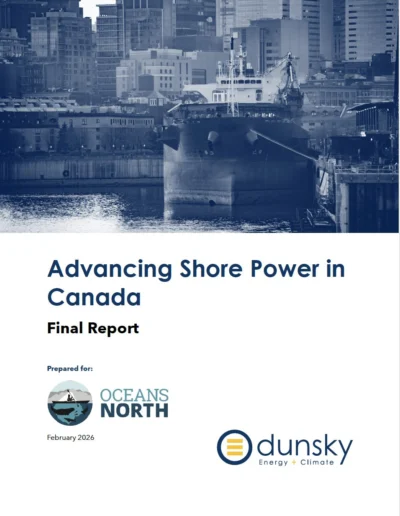
Advancing Shore Power in Canada, prepared for Ottawa-based Oceans North by Dunsky Energy + Climate Advisors, provides an in-depth look at the impact of ships running their engines at berth and identifies opportunities to accelerate shore power implementation across Canadian ports, with a focus on the largest: Vancouver, Prince Rupert, Montreal, Saint John, and Halifax.
The report notes that only 4 of the 17 Canada Port Authorities operate standardized high-voltage shore power systems, and fewer than 5 percent of cruise and container ships berthed at Canada’s busiest ports shut down their auxiliary engines to plug into the grid.
Across the five ports assessed, shore power is provided as an interruptible service with a fixed energy charge. As with any other major infrastructure investment, scaling shore power requires planning and coordination among utilities, other grid users, and ports.
Forecasted growth in trade and tourism, combined with major port expansion projects, will compound the negative impacts of burning fossil fuel at berth. Major expansions at the Ports of Vancouver and Montreal are expected to increase container vessel traffic by 30 percent and 60 percent, respectively.
Each year, thousands of ships call at Canadian ports. More than 95 percent continue to run their diesel engines while parked at berth to power systems like refrigeration and heating. Burning this fuel contributes to climate change and—especially so close to population centres—negatively affects human health, reducing lifespans and adding costs to our health care system. A large cruise ship at berth for 10 hours burns as much fossil fuel as is needed to power a small city the size of Nelson, B.C.
Shore power enables ocean-going vessels to plug into the electricity grid rather than run their auxiliary engines to generate power while at berth. This technology has been utilized for 25 years, with mandatory connections regulated in California, the European Union and China, and is widely recognized as a scalable and effective means to improve local air quality, mitigate climate impacts, and reduce fossil fuel use in the marine sector.
However, according to a benchmarking study released last year comparing Canada’s busiest ports to the world’s, shore power infrastructure has been deployed at only a small proportion of the total terminals and berthing locations necessary for widespread adoption in our country. The new report provides recommendations to attract best-in-class, shore-power capable ships and generate investments in infrastructure and technology that will allow our ports to keep pace with our trading partners and competitors.
“While individual ports face unique opportunities and barriers when it comes to expanding shore power, the biggest obstacle right now a lack of federal leadership,” says Amy Nugent, Oceans North’s Associate Director of Marine Climate Action.
“Transport Canada needs to step up and provide federal regulations and adequate infrastructure funding, or ships will simply continue to run dirty engines while parked in the middle of Canada’s coastal cities. Failure to act will mean that companies will send their shore-power equipped ships to other ports where connection is regulated, and send their dirtiest ships to Canada where it is virtually free to pollute.”
The report suggests several key policies, including a requirement that all berths at Canadian Port Authorities can provide shore power by 2035, and that large ocean-going vessels are required to connect to it. In order to achieve these goals, the government could develop a Federal Port Electrification Investment Strategy, which would start right away by funding port authorities to develop detailed feasibility and design studies and collaborate with utilities to ensure that there is sufficient interconnection planning, transmission, and distribution.
“Our research shows that shore power could reduce GHG emissions by nearly 170,000 tonnes annually, more than ten times what current deployment has achieved,” says Brendan McEwen, Managing Consultant at Dunsky. “By providing policy and regulatory certainty, federal action can help grid planners anticipate the needs of the marine sector and allow it to play a larger role in decarbonizing our economy and improving the health of our port communities.”
The report also recommends that shore power be integrated into existing and planned port expansions where it can be added at a lower cost. For example, additional shore power capacity is already part of the new development plans at the Contrecoeur Terminal at the Port of Montreal and the Robert Banks 2 Terminal at the Port of Vancouver.
“Despite government funding for shore power, the cost of new infrastructure is still a barrier for ports wanting to implement shore power and is causing ports like the Greater Victoria Harbour Authority and the Port of Quebec to halt plans,” says Brent Dancey, Director of Marine Climate Action at Oceans North. “Our next step with this report is to engage governments, ports, and port communities to revive shore power projects and explore funding solutions that leverage the $5 billion federal Trade Diversification Corridor Fund and work with the international companies responsible for degrading air quality in port communities to pay their fair share of cleaning up the mess.”
Response of Daniel-Robert Gooch, President and CEO of Association of Canadian Port Authorities
Responding to the report, ACPA’s Daniel-Robert Gooch declares: “Canada’s 17 port authorities are actively expanding shore power where it makes sense as part of their sustainability commitments, alongside other initiatives such as improving the efficiency of vessel and vehicle movements. Federal infrastructure funding for shore power and programs such as the National Trade Corridors Fund and the Green Shipping Corridors Fund, which typically fund up to 50% of project costs, have been helpful in supporting port infrastructure investment, with approximately $1.5 billion distributed to Canada Port Authorities over the past decade.
“Installing shore power at all berths across all 17 CPAs would cost hundreds of millions of dollars and, in many cases, may not represent the most effective use of infrastructure investment. Mandating such a requirement would be costly, a burden the federal government would be unlikely to fully assume, and could divert attention from other priorities as CPAs work to upgrade aging infrastructure and support the federal government’s trade diversification goals.”
(Report image from Oceans North)