
The Drewry World Container Index (WCI) increased 6% to $2,712 per 40ft container, mainly due to higher freight rates on the Asia to Europe trade route. The composite index rose for the third week this month.
On the Asia–Europe trade route, spot rates increased this week, supported by early peak season demand and higher FAK levels. Freight rates from Shanghai to Rotterdam surged 15% to $2,773 per 40ft container, and those from Shanghai to Genoa jumped 10% to $4,082 per 40ft container. According to Drewry’s Container Capacity Insight, only three blank sailings have been announced on the Asia to Europe trade route for next week, indicating higher capacity deployment to accommodate peak season cargo.
CMA CGM has announced new FAK levels, effective 1 June, which are set above current levels, with Asia–Europe rates at around $4,700 per 40ft container and Asia–Mediterranean rates in the range of $5,500–$5,700 per 40ft container. As the early peak season looms, with carriers continuing to raise FAK levels, Drewry expects rates to increase further in the coming weeks.
On the Transpacific trade route, rates increased slightly this week. Freight rates from Shanghai to New York grew 2% to $4,317 per 40ft container, and those from Shanghai to Los Angeles soared 1% to $3,385 per 40ft container. According to Drewry’s Container Capacity Insight, seven blank sailings have been announced on the Transpacific trade route for the next week, indicating tighter capacity and creating scope for carriers to implement higher FAK rates. Early peak season trends are also expected to emerge on the Transpacific trade lane. ONE has announced a PSS of $2,000 per 40ft container on Transpacific eastbound cargo, effective 1 June. Drewry expects rates to increase in the coming weeks.
Overall, East–West container freight markets are firming as the peak season arrives earlier than usual this year. Carriers are pushing rates higher through increased FAK levels and PSS, while also tightening supply through blank sailings and selective capacity management.
Meanwhile, ongoing geopolitical tensions in the Middle East have disrupted global shipping sentiment, with emergency fuel surcharges and elevated bunker costs adding further uncertainty and upward cost pressure across trade lanes.
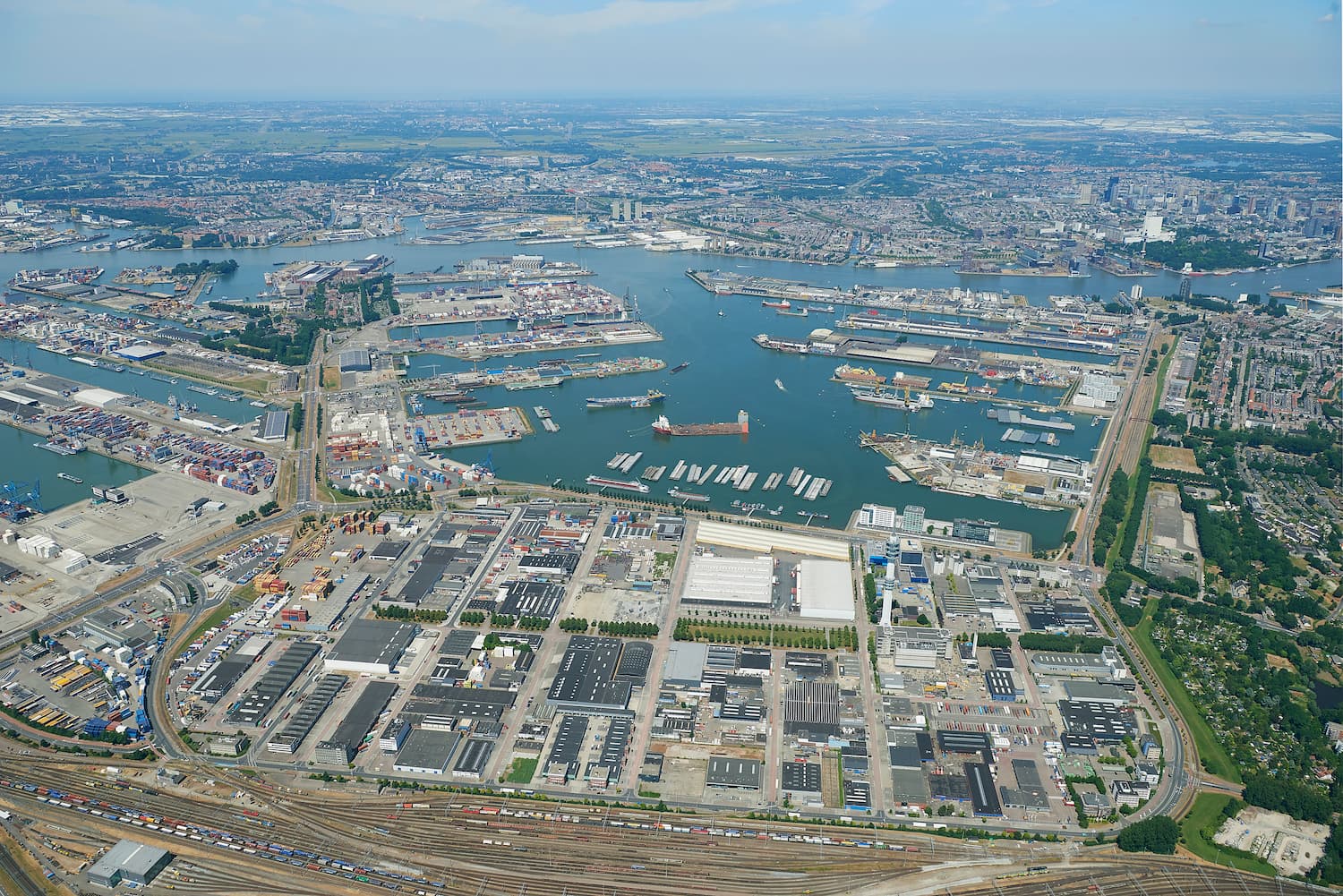
(Port of Rotterdam photo)