
Niels Rasmussen, Chief Shipping Analyst at BIMCO, forecasts “continued strong market conditions for crude tankers in 2026 and 2027 despite some weakening in 2027. On the other hand, we forecast that the product tanker market will weaken during both years as fleet and supply growth accelerates.”
According to the International Energy Agency, global oil demand will grow 0.9 million barrels per day (mdpd) in 2026 whereas oil supply is expected to grow 2.4 mbpd. Oil market oversupply is thus expected to increase and peak at 4.1 mbpd in the second quarter of 2026.
The U.S. Energy Information Administration (EIA) expects faster demand growth of 1.2-1.3 mbpd per year during 2026-2027 while predicting weaker supply growth of 1.6 mbpd and 0.9 mbpd in 2026 and 2027 respectively. The EIA forecast that the oil market oversupply will peak at 3.2 mbpd in the first quarter of 2026.
“Due to the oil oversupply, the EIA forecast that the average price of Brent will fall from USD 69/barrel in 2025 to USD 58/barrel and USD 53/barrel in 2026 and 2027 respectively. That is likely to support continued inventory expansion during 2026. Currently, US/Iran tensions have, however pushed prices above USD 70/barrel,” says Mr. Rasmussen.
“The inventory expansion is expected to continue to support crude tanker market strength, which may also offer increased opportunity for product tankers to engage in the dirty tanker market. We are meantime concerned that inventory expansions could end in 2027, and we may even see inventory drawdowns instead.”
The increasing pressure on the sanctioned and parallel fleet may offer opportunities for mainstream tankers. Venezuelan oil exports have already shifted to the mainstream fleet and any reduction in Russian and Iranian oil exports could add further support.
While the Strait of Hormuz has never been fully closed, there is a risk of disruptions or temporary closure if US/Iran tensions escalate. If that happens, 30% of global seaborne oil exports may no longer be available to the market.
Since our last report, the capacity in the crude tanker order book has increased 24% while the product tanker order book is up 5%. The order book/fleet ratio therefore stands at 18% and 19% for crude tankers and product tankers respectively. Unless recycling activity ends higher than our current forecast, a supply driven weakening of the markets is therefore likely in the coming years.
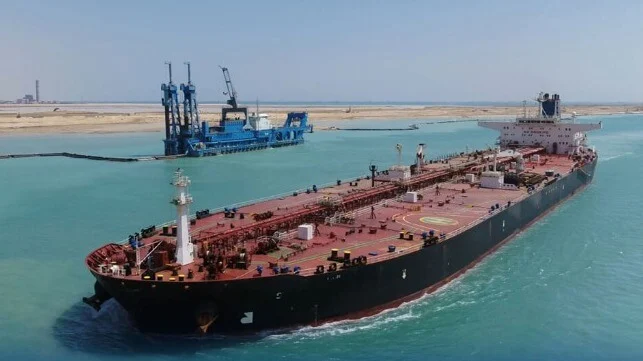
(Photo of tanker in Suez Canal)