

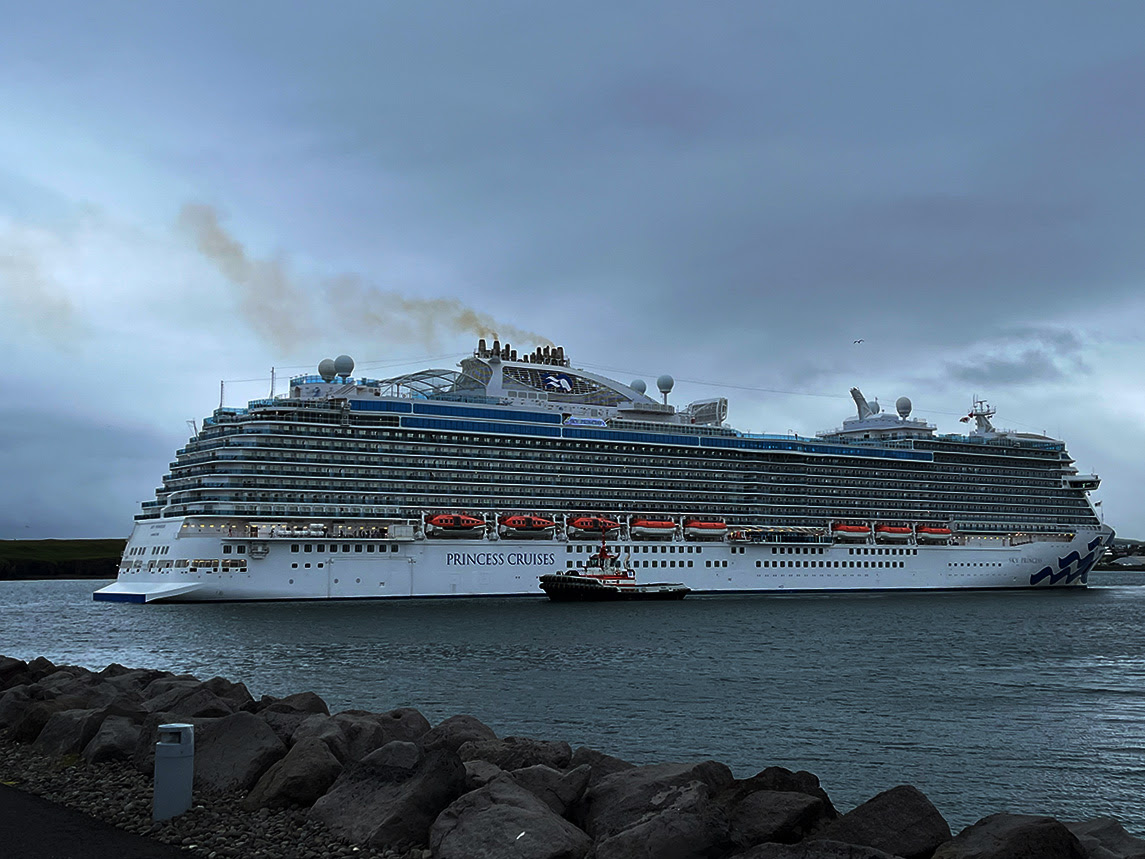
Reykjavík – Air quality measurements recorded during visits of cruise ships – such as the Viking Mars and Sky Princess – to the port of Sundahöfn, in Reykjavík, Iceland, show high air pollution levels with an average of 35-40 times higher than safe low particle levels recommended by the World Health Organization (WHO) – 1,000 particles/cm3, according to a press release from the Clean Arctic Alliance outlining the findings of two Alliance members.
The measurements, made on July 7th, contained a high content of soot (black carbon) which is toxic to human health and a strong climate pollutant that drives warming of the Arctic. Similarly high pollution levels were measured on July 11th in Reykjavík harbour – close to populated city areas, where smaller cruise ships and boats are not always able to connect to onshore electrical power.
Smaller cruise ships and boats can use a shore-based electrical connection (onshore power) rather than running their engines in Reykjavík’s harbour. However, at the much larger Sundahöfn Port nearby, ships cannot yet use shore power, pending a power plant coming on stream in 2028.
The measurements, taken by Dr Kåre Press-Kristensen, senior advisor on air quality & climate at Green Global Future, found average concentrations measured while the cruise ships were in port were around 35-40,000 particles/cm3, peaks in the ships’ main smoke plume were above 100,000, falling to around 1000/cm3 when the cruise ships departed the port, suggesting that residents in Reykjavik are regularly exposed to high levels of air pollution when wind is towards the city from the cruise port.
Such pollution increases the risk of strokes, cardiovascular diseases, lung diseases, cancer, and as a result, the risk of premature mortality among residents. In addition, soot particles are a key driver for global warming. See WHO info on health risks.
“It’s certainly welcome that Iceland has decided to install onshore power for cruise ships allowing cruise ships to use clean Icelandic electricity when the plant is ready in 2028, instead of idle running all day in the port”, says Dr Kåre Press-Kristensen. “However, to rapidly reduce emissions at sea, shipping around the Arctic, including in Iceland’s waters, ships must switch to distillate fuels – increasingly identified as polar fuels – like marine gas oil.
“Iceland can promote this by supporting a proposal on polar fuels at the International Maritime Organization banning scrubber water discharges in territorial seas as recommended by OSPAR, and as other Nordic nations have done; as well as by establishing a green corridor between Reykjavik and Nuuk thereby protecting the very fragile Arctic ecosystems”, added Press-Kristensen. “The expense of installing shore power facilities will be recouped through
connection fees and electricity sales much faster than for traditional infrastructure projects. This will eliminate local pollution from ships at berths, improve public health in the wider vicinity and reduce global warming.”
“Iceland should start monitoring air pollution at all ports in Iceland and support the Nordic Council recommendation for action at the International Maritime Organization (IMO) by joining the Danish-led proposal on polar fuels currently on the table for consideration at the IMO, thus mandating the need for cleaner fuels in Icelandic waters”, said Arni Finnsson, Board Chair at the Iceland Nature Conservation Association. “Iceland should also move towards implementing a scrubber water discharge ban, adoption of green corridors, provision of onshore power for fishing vessels, and construction of electric fishing vessels. These are all low hanging fruits which will contribute to reducing air pollution and global warming caused by shipping, as well as creating energy supply safety for Iceland.”
(Photo by Kare Press-Kristensen)