
By Michael Grey*
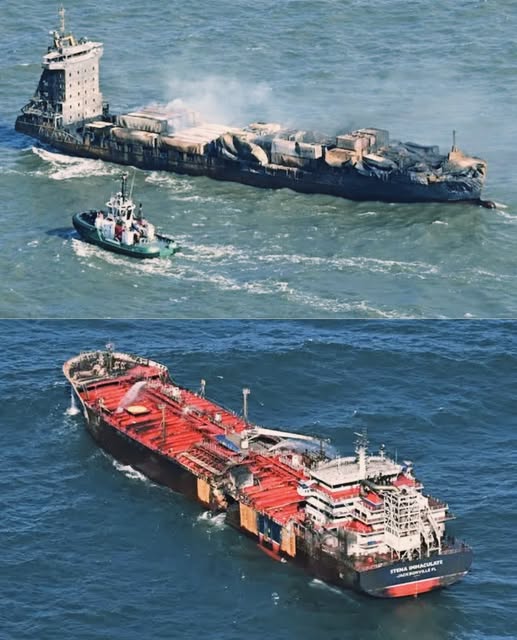
There can be few who were even remotely surprised at the guilty verdict and six-year jail sentence for the master of the container feeder Solong, which plunged like a misguided missile into the side of the anchored Stena Immaculate off the Humber last March. There seemed to have been no rational explanation for the incident, which killed one of the Solong’s crew and wiped out his ship, which failed to make any alteration of course before the fatal collision.
Nobody would suggest that the sentence was unduly harsh, the Russian master, who has been held in custody since his arrest shortly after being rescued, doubtless being thought a “flight risk”. The fact that the tanker was US registered and carrying a military cargo may well have weighed upon the minds of police investigators, and others. But geo-politics aside, there are perhaps wider questions that this incident, among the worst of recent navigational calamities, should provoke.
It might, for instance, be asked why the master of a sizeable ship, was keeping a navigational watch as a matter of routine. In the world of containerships, this was just an insignificant feeder, but was nevertheless the dimensions of an ocean-going ship which, in an earlier age, would have had a deck department of at least three officers to keep the watches and sufficient ratings to assist. The answer is quite obvious; in the “normalisation” of such manning in these trades; something that has come about without any proper discussions, driven purely by the need to stay competitive. If company A can make do in such a “schooner-rigged” fashion, then companies B,C,D etc must follow, if they are to satisfy charterers looking for their pound of flesh and keep their business.
Is it reasonable for the master of a ship, which is being driven hard in an unremitting service in which the maintenance of a schedule is paramount, to be expected to act as an OOW (Officer of the Watch)? It is also worth considering what will be expected of masters, additional to their watchkeeping and supervisory duties before, during and after the vessel’s numerous port calls, with innumerable calls upon their time, from the terminal staff and all the other well-rested officials who demand attention. An unending requirement for reporting, bureaucratic demands whizzing into the email inbox, all wanting instant answers.
Impact of fatigue in watchkeeping
Masters of these ships, in regular trades, are often expected to hold pilotage exemptions and to handle their ships, in what may be long, estuarial pilotages. Might fatigue just possibly be a contributor to some – even most – of these navigational accidents, which now seem to be almost accepted as part of the price of progress in keeping the logistics chain bar-tight? In the current journal of the International Federation of Ship Masters’ Associations is a sad observation about the premature retirement of a ro-ro master, whose health was breaking down due to the pressure of multiple port calls. The current Nautical Institute Seaways, in its current issue, has a whole collection of accounts of fatigue-related accidents, along with some thought-provoking articles about the reality of life at sea today.
There is nothing even remotely revelatory about all this; there have been warning after warning, but beyond bureaucratic changes around “hours of rest” requirements which has given rise to creative reporting, little has been done to address the real issues.
Clever manufacturers produce equipment that produces precision navigation solutions, but relegates the fatigued OOW to the role of a machine-minder, alarm-canceller and a pair of bleary eyes. Brilliant engineers produce port equipment that will halve the time in port for a turn-round, to huge congratulations from everyone, except perhaps for the ships’ crews, who will have to do the same jobs, but in half the time. Bullying greens persuade ship operators to slow ships down at sea to save the planet, requiring ports to look to their even greater efficiencies.
And at the end of all this progress are to be found the human beings who run the ships, the only folk who do not get a full night’s sleep, and find that they start nodding off at the controls, as the cumulative effects of sleep loss build up. It is worth noting that it is the health of frail human beings who have paid the price for the astonishing improvement in productivity that is represented in modern shipping.
Who thought it such a tremendous wheeze to get rid of the radio officer, just at a time when bureaucracy was multiplying and ship-shore communications were getting out of hand? The same great financial brains who have halved the manpower available, but doubled the workload of the survivors. The human price has been more than those whose lives and careers have been ruined in accidents and poor health, as the enjoyment has been leached out of seafaring, and that should matter to us all.
(Image from Naval Nostalgia Facebook)
*Michael Grey is former editor of Lloyd’s List. This column is published with the kind permission of The Maritime Advocate.