
By Michael Grey*

A nuclear reactor, I can recall my father, who was a naval engineer, explaining, was just “an advanced form of kettle” and nothing to be too excited about. I can remember him shaking his head at the decisions to fit warships with gas turbine propulsion, about the same time as I was going to sea on motor merchant ships, which could go all the way to the Antipodes without refuelling.
Today we would describe it as the “range anxiety” that deters so many from electric cars. The first efforts to get nuclear merchant ships up and running never really caught on, and only the Russian icebreaker fleet, operated by the state and taking little account of cost and public opinion, have stood the test of time. But the topic eventually returns, usually driven by fuel price, but more recently by the demands for clean alternatives to hydrocarbons and “net zero.” The recent arrival of the UK Maritime Nuclear Consortium is what might be thought of as the latest chapter in this long and fascinating debate.
Under the aegis of Lloyd’s Register alongside experienced players, it is hoped that a regulatory pathway to safe and acceptable nuclear propulsion might be developed and that the UK will be in a position to grasp this potential. It was during one of the earlier periods, when soaring fuel prices raised the topic of nuclear power alternatives that I listened to a well-argued exposition by a LR senior surveyor at a presentation in London. It was a long time ago, but I recall him outlining the barriers which, he said would have to be overcome if a commercial nuclear power at sea was ever to progress. There were few technical obstacles, but the development and capital costs, the practicability (availability of expert staff etc) and the need to overcome the concerns of the public as regards safety remained formidable.
Between then and now, has anything really changed? It might reasonably be argued that the technology has greatly advanced and it has been proved that small nuclear reactors are a very practical proposition and can be further miniaturised for merchant ship propulsion.
There is ground-breaking research going on in several parts of the world along these lines, for barge-mounted power plants, desalination, and the like. An Australian designer has proposed an interesting concept employing a nuclear-powered ship to work commercially around the islands of the Pacific and when in port charging up the island’s battery banks, saving them a fortune in imported fuel. But despite the passage of years, the barriers still remain.
Memories of Chernobyl and Fukashima have never entirely gone away and the questions of nuclear decommissioning remain alive, albeit somewhat shrugged off by the experts. In Devonport and Rosyth, the reactors aboard most of the Navy’s retired submarines lurk in their darkened hulls, waiting for the Treasury to grudgingly eke out the next tranche of funds to take them to bits, one by one in a process they never ever seem to be catching up on. And that is a government that drags its feet in this fashion – could we ever be certain that the commercial world, in the shape of even the biggest shipping company, could be persuaded to take on such a burden? So many unknowns. Just think of the way that the oil companies, which so eagerly promised the earth when they wanted to plant their rigs in offshore waters, tried to wriggle out of their obligations to restore the seabed when the oilfields had been sucked dry, suggesting cheaper and more expedient alternatives.
Not an attractive analogy, perhaps. The concept of nuclear powered, ships operating at speeds no longer thought acceptable in our planet-saving era, seems hugely attractive to those of us that mourn the death of speed at sea. But even if you could find a major operator – even a consortium – willing to shoulder the cradle-to-grave responsibilities, and convince some progressive ports in some willing countries to admit these greyhounds, there are still so many “buts.” They may be fuelled up for a lifetime, but can the ships, let alone the terminal ports, be insured at an affordable cost? Where is the specialist manpower going to come from, when nuclear navies are finding it increasingly difficult to recruit and retain properly qualified and experienced engineering officers? And in terms of personnel, there are no short cuts to be had with such power plants. You would not be able to persuade even the most pliant administration to grant a dispensation, when the holder of a Second Engineer (Nuclear) certificate failed to sign on.
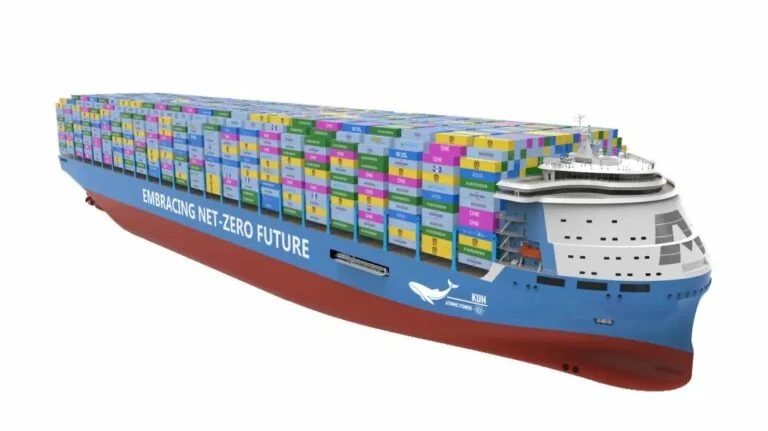
(Photo from Japan’s Jiangnan Shipyard of design for world’s largest nuclear-powered containership.)
*Michael Grey is former editor of Lloyd’s List. This column is published with the kind permission of The Maritime Advocate.