
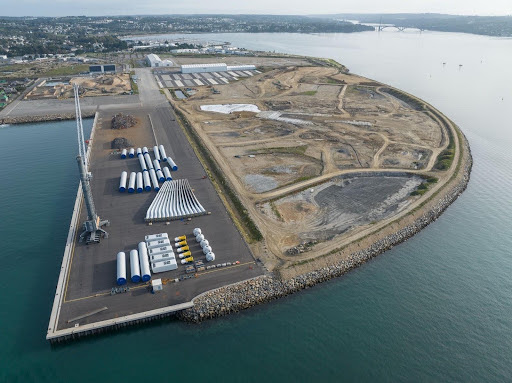
Following the announcement of France’s ambition to roll out floating wind power on a massive scale, with 45GW planned by 2050, BrestPort has received €58 million in state funding granted to adapt its infrastructure. This confirms Brittany’s position at the forefront of floating wind projects along France’s Atlantic coast and in the Celtic Sea.
The long-term strategy is based on the synergy of two major sites: the port of Brest is establishing itself as the platform for the assembly and integration of the floats, while the port of Lorient is set to become a strategic base for services, mooring logistics and maintenance at the heart of future offshore wind farms.
In practical terms, the InFloW project will enable Brest to centralise the entire industrial value chain for floating wind power on a single site. The terminal will handle the manufacture and storage of giant components, the integration of turbines and complex launch operations. The planned investments will strengthen the quays and logistics areas to accommodate very large-scale industrial operations. By 2050, this assembly hub is expected to generate around 4,000 jobs and prevent the emission of 850,000 tonnes of CO₂, firmly anchoring Brittany in the European energy transition value chain.
Some 100 nautical miles to the south, Lorient forms the second pillar of this project. Strategically positioned close to the future wind farms of southern Brittany, including the Pennavel site France’s first commercial-scale floating offshore wind farm (250 MW) the Port of Lorient aims to host construction and installation operations, particularly for the mooring lines of floating wind turbines for the Atlantic coast market, in addition to maintenance activities.
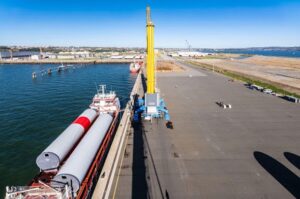
(Photo of Brest by FLYHD and of Lorient by Matthieu Le Gall)