
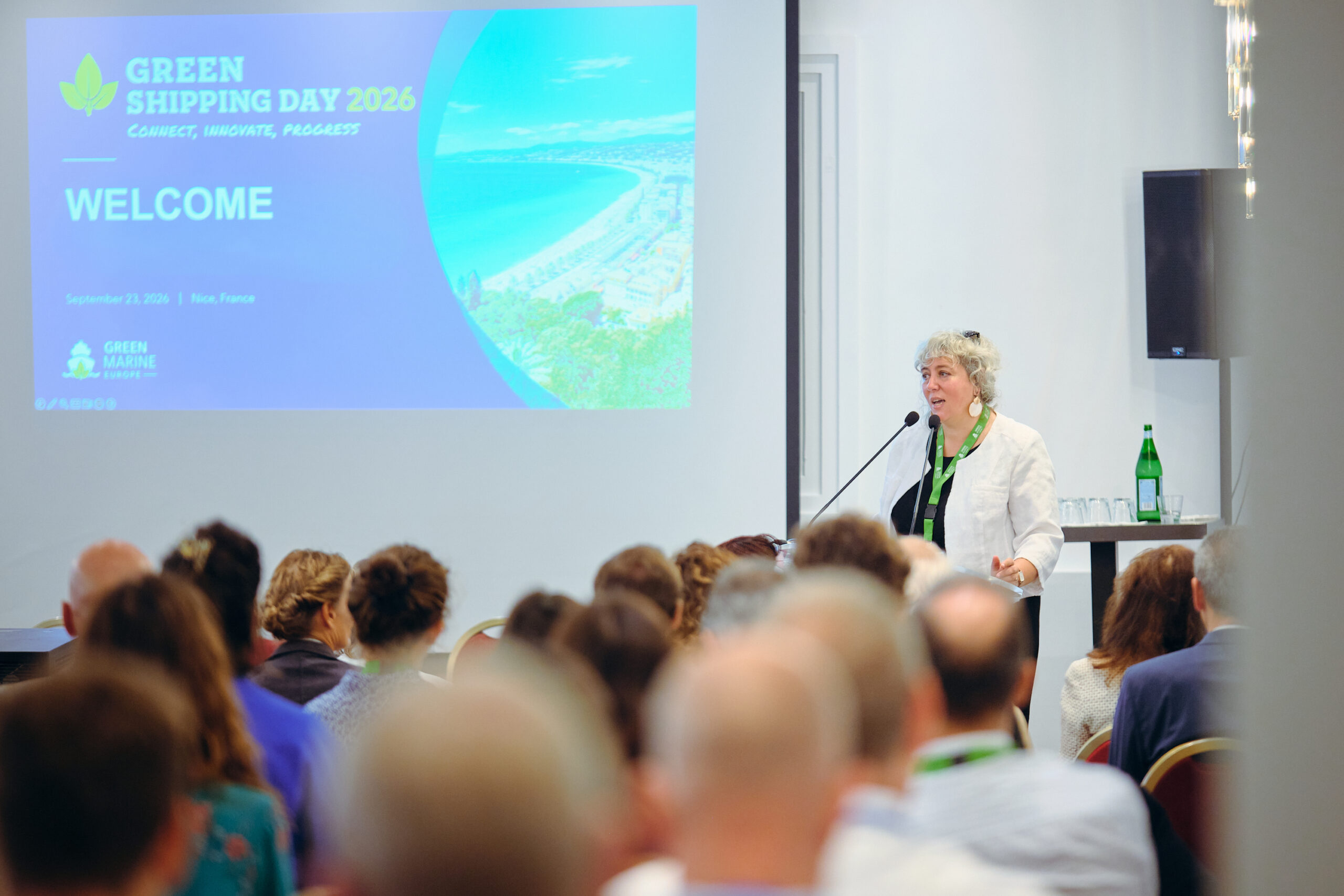
Nice, France – Green Marine Europe has published its 2025 Performance Report, presented during Green Shipping Day, the certification program’s 7th annual event, held this year in Nice. Green Marine Europe now brings together 47 organisations across its Ship owners, Shipyards and Ports programs. Of these, 37 participants have completed the certification process for actions carried out in 2025.
The number of European participants has also increased by 30% over the past year, while the wider Green Marine Europe community surpassed the 100-member threshold in 2026.
Antidia Citores, General Manager, Green Marine Europe, declared: “The maritime industrial and ports strategies published by the European Commission last March call for the sector to simultaneously strengthen its competitiveness, sustainability, resilience, innovation and investment capacity.
“Green Marine Europe is directly contributing to this momentum. By bringing together ship owners, shipyards and now ports around a common, measurable and verifiable framework, our program helps translate these European priorities into concrete pathways for progress.”
Improving results among ship owners and shipyards Ship owners remain the program’s largest group, with 29 companies certified for their 2025 performance. Their average performance level increased from 2.5 to 2.6 out of 5.
Among the 25 ship owners with at least two years of comparable results, 60% improved their performance, eight remained stable and two recorded a decline. The trend is even stronger among shipyards. The program has grown from four to seven participants, an increase of 75%, with six certified for 2025. All four shipyards with comparable results improved their performance, with their average level increasing from 2.1 to 2.4 out of 5.
Integration of ports
The 2025 Performance Report also marks an important milestone with the integration of ports into the certification program. Eight port authorities (Port of Santander · Port of Cartagena · Port d’Atlantique La Rochelle · Port of Bayonne · Port Charente Atlantique · Grand Port Maritime de Bordeaux · Port Autonome du Centre et de l’Ouest) now form the first European cohort. The ports of Santander and Cartagena entered the certification process based on actions carried out in 2025 and have become the program’s first two certified port authorities.
Six other ports will evaluate their 2026 operations in 2027. With the first two results now available, their average performance level of 2.5 provides an initial benchmark and confirms that the framework can be applied to different European port contexts.
As the cohort expands, it will gradually provide comparable data and help build a European community of practice.
Green Marine Europe: the European component of an international movement
As of summer 2026, the international network brings together 224 participants, 72 associations, 122 partners and 155 supporters — 573 organisations in total. Green Marine International is now active in North America, Europe and Australia, while several pilot projects have contributed to expand the program into new regions in the Southern Hemisphere. This international dimension is based on a common structure: maintaining shared environmental standards while enabling regional programs to adapt their criteria and implementation methods to local regulatory and operational realities.
The 2025 Performance Report is also being published as Green Marine International rolls out its first three-year strategic plan, designed to support its international development, strengthen governance across regions and ensure that the program evolves in line with scientific knowledge, regulations and industry expectations.
“As Green Marine International’s reach, stakeholder diversity, and global ambitions continue to grow, our first three-year strategic plan provides us with a clear and shared roadmap,” stated David Bolduc, President and CEO, Green Marine International. “It will enable us to strengthen our programs, guide our international expansion and continue, like a lighthouse, to show the way towards more sustainable maritime transportation across oceans and borders.”
(Photo from Green Marine Europe)