

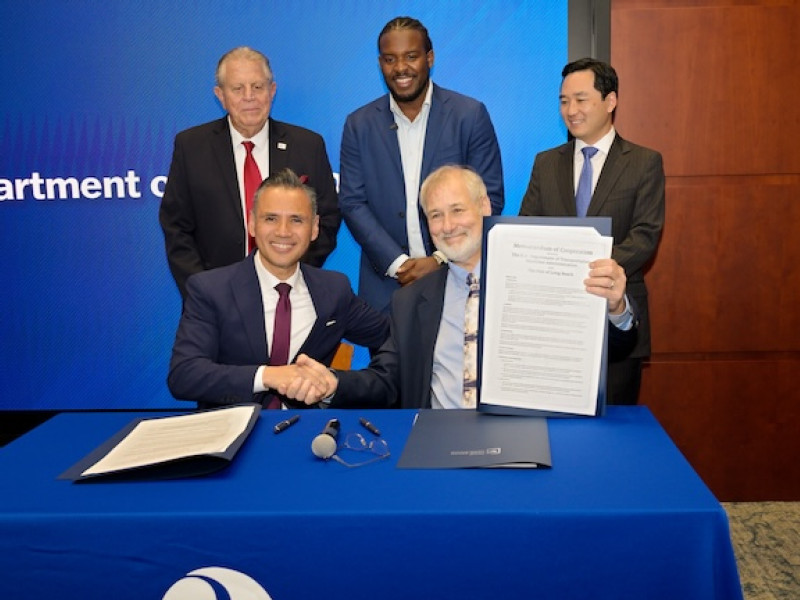
The U.S. Department of Transportation’s Maritime Administration (MARAD) today joined leaders from California’s Port of Long Beach to celebrate a new partnership focused on exploring small modular reactor (SMR) technology. Developments in SMR will be used to revitalize U.S. shipbuilding, cut costs, and secure energy dominance.
“Under President Trump’ and Secretary Duffy’s leadership, MARAD is taking decisive action to revitalize U.S. shipbuilding and secure our national energy dominance,” said Maritime Administrator Stephen M. Carmel. “This milestone agreement with the Port of Long Beach brings cutting-edge Small Modular Reactor technology into active testing. It ensures our maritime supply chains stay operational under any contingency while training the next generation of high-skilled American mariners.”
The agreement was signed by MARAD Administrator Captain Stephen Carmel and Dr. Noel Hacegaba, Chief Executive Officer of the Port of Long Beach. Also in attendance was Long Beach Board of Harbor Commissioners President Frank Colonna, federal transportation officials, maritime industry leaders, and energy sector stakeholders.
“This first of-its-kind partnership with MARAD allows us to leverage strong federal leadership and private sector innovation to catalyze SMR technology as we safely and securely support the next generation of shipping,” said Port of Long Beach CEO Dr. Noel Hacegaba. “We’re building the Port of the Future in Long Beach, where we’ve led in global trade by moving $300 billion in cargo annually to support 2.7 million American jobs, and we will continue our tradition of leadership as we partner to advance nuclear energy in maritime and beyond.”
Through a Memorandum of Cooperation (MOC), MARAD and the Port of Long Beach agreed to work together to explore opportunities to advance maritime energy systems, including through the potential integration of SMR technologies, resilient port microgrids, shoreside power architecture, infrastructure capable of supporting emerging vessel propulsion concepts, and related workforce development opportunities.
(Photo from US Department of Transportation)