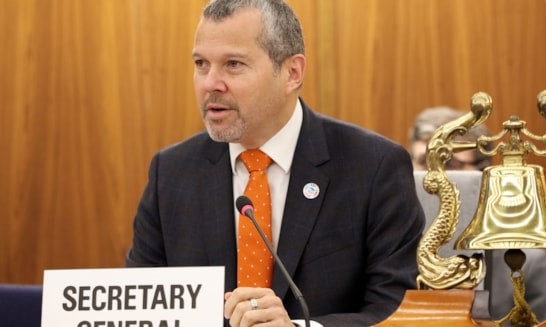
Secretary-General Arsenio Dominguez today delivered opening remarks at IMO headquarters in London, as the Marine Environment Protection Committee (MEPC) met to discuss until Friday the adoption of global regulations to reduce greenhouse gas emissions from international shipping.
The meeting was taking place after the Trump Administration’s weaponization of trade and shipping had reached an unprecedented level last Friday by threatening to sanction countries that vote in favour of a proposed NetZero Framework (NTZ). On the other hand, it is strongly backed by the European Union. Through associations like the International Chamber of Shipping, the global shipping industry has also expressed strong support for the NTZ.
IMO aims for net-zero emissions by 2050, with 20% reduction by 2030, 40% carbon intensity reduction by 2030, and 5% zero-emission fuel use by 2030.
The IMO Net-zero Framework is the first in the world to combine mandatory emissions limits and GHG pricing across an entire industry sector.
Approved by the Marine Environment Protection Committee during its 83rd session (MEPC 83) this past April, the measures include a new fuel standard for ships and a global pricing mechanism for emissions.
These measures, slated to be formally adopted in October 2025 before entry into force in 2027, will become mandatory for large ocean-going ships over 5,000 gross tonnage, which emit 85% of the total CO2 emissions from international shipping.
A fund, expected to receive billions annually, will be used to reward low-emission ships, fund research and infrastructure, and support a “just transition” by providing capacity building and technology transfer to developing countries.
“I am aware that some of you may find the outcome not climate ambitious enough, and would have liked to see steeper reduction curves to effectively contribute to reducing global warming,” Mr. Dominguez noted. Others, believe that the GFI reduction requirements are overly stringent and will place a burden on the shipping industry.
“Some of you are of the view that there will not be sufficient alternative fuels available to ensure compliance, whilst others believe that robust global regulations will send a clear demand signal to fuel and energy producers. Some of you would have preferred a stronger commitment to supporting developing States. Others would prefer additional support for early-movers.
“All these views continue to be valuable. And also during this week all these different positions will be respected.
The IMO Net-Zero Framework is not perfect. However, it provides a balanced basis for our further work on a number of elements ahead of its entry into force in 2027.”
In their joint statement, U.S. Secretary of State Marco Rubio and Transportation Secretary Sean Duffy warned that countries supporting the IMO’s decarbonisation plan could face port bans, visa restrictions on seafarers, punitive vessel fees, and even sanctions on government officials deemed to be “sponsoring activist-driven climate policies.”
The statement affirmed: “The administration unequivocally rejects this proposal before the IMO and will not tolerate any action that increases costs for our citizens, energy providers, shipping companies and their customers.”
(Photo from IMO)