

Sector outlooks for North America and EMEA Seaports are ‘deteriorating’ for 2026, while Asia-Pacific and Latin America ports appear to be better weathering policy uncertainty and the tariff war, according to the Fitch Ratings Global Seaports Outlook 2026.
“The ‘deteriorating’ outlook for EMEA reflects Fitch’s expectations for modest or stagnant seaborne trade as higher tariffs take effect,” noted the report. “We expect Eurozone GDP growth to be about 1.3% in 2026. The long-term U.S.-China trade path is the key uncertainty in our outlook. European operators face divergent volume trajectories and softer trade conditions.
“Ongoing Red Sea/Suez security risks and sanctions-driven re‑routing are reshaping flows, with uneven Mediterranean and Northern Europe trends. Capacity additions at Antwerp and Rotterdam, as well as Türkiye’s Mersin and Limak’s 2027 expansion, aim to ease strains after 2025’s near‑maximum utilization and labor‑related delays.”
The report continued: “In North America, ports are facing disruptions from policy shifts. Fitch expects nominal declines in 2026 volumes amid low GDP growth and an adverse tariff environment. A temporary U.S.‑China de‑escalation offers limited relief. However, higher U.S. tariffs on raw construction materials may raise capital input costs or delay projects. Cruises provide a partial offset but remain sensitive to consumer confidence.”
‘Neutral’ outlook for Asia-Pacific, Latin America seaports
“The outlooks for APAC (Asia-Pacific) and Latin America Seaports are ‘neutral’, which reflects relatively resilient regional dynamics. In APAC, volumes are cushioned by strong intra-regional activity, while recent trade agreements with the U.S. have reduced uncertainty for exporters.
“In Latin America, maritime trade remains resilient, supported by strategic trade lanes and rising agricultural exports, and seaport throughput is expected to extend 2025’s rebound, despite tariff and geopolitical challenges.”
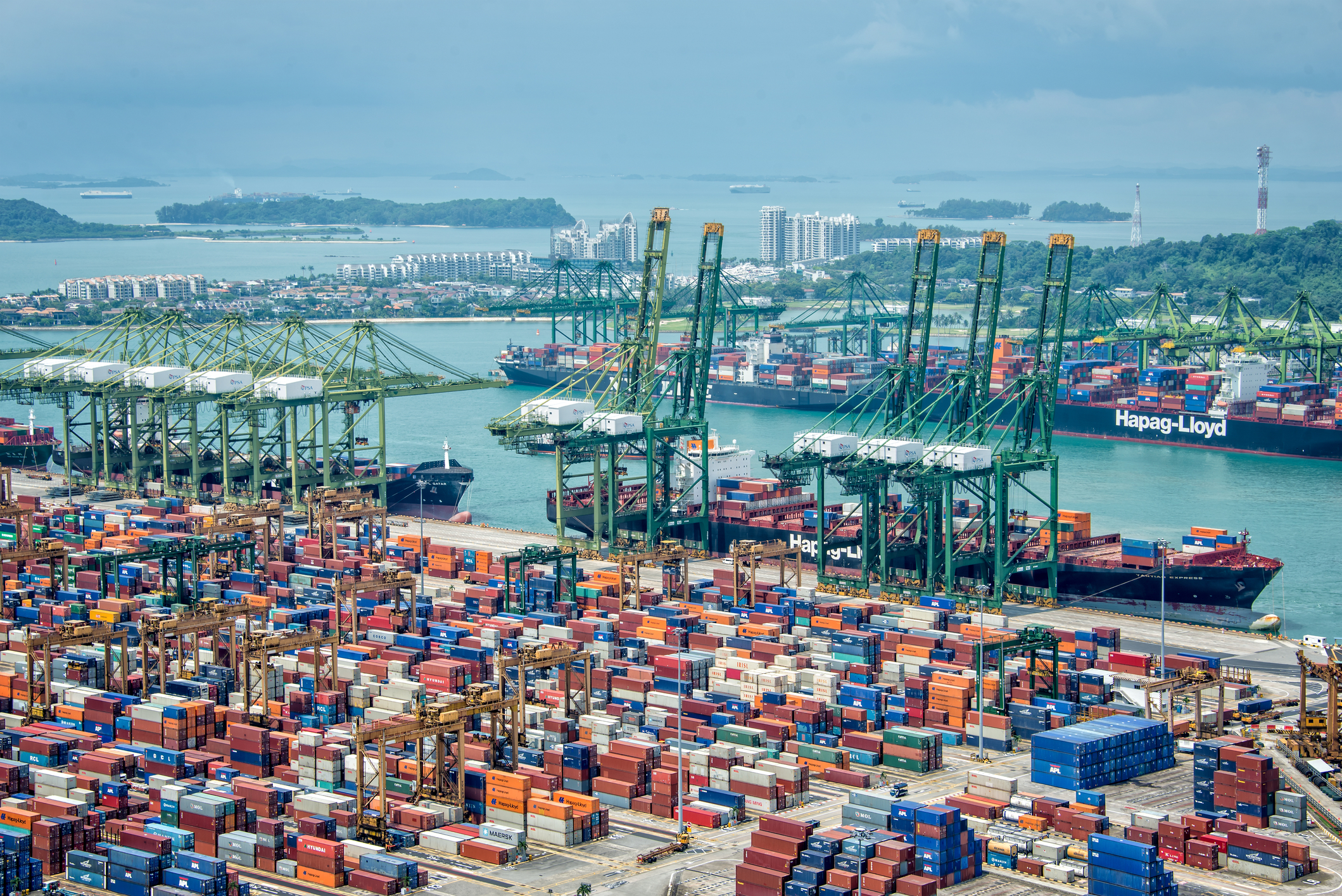
(Dreamstime photo of Port of Singapore)