Responding to today’s publication of the EU’s Arctic Strategy, which definitively states the EU’s intention to support International Maritime Organization (IMO) regulations that would regulate the impacts of black carbon emissions from ships on the Arctic, Andrew Dumbrille, Special Advisor to the Clean Arctic Alliance and co-director of Equal Routes, said : “Canada should align with the clear signal sent by the EU decision to prioritise cutting of black carbon emissions from shipping.
“Canada has already shown leadership by joining the COP30 black carbon pledge, and by bringing its Arctic emission control area into force. Canada’s next step should be to match the EU’s ambition by backing a mandatory polar fuel measure at the IMO that covers the full Arctic.
“Black carbon from shipping is accelerating the melt of sea ice in the Arctic region, which is warming four times faster than the rest of the planet”, added Mr. Dumbrille. “Reducing black carbon emissions protects local community food systems, the integrity of Canada’s Arctic waters, and the ability to steward them. Acting alongside the EU is also a matter of sovereignty, it means Canada is setting the standards for Arctic shipping rather than leaving their definition to others. Arctic states, led by Canada, should work with the EU to close this regulatory gap.”
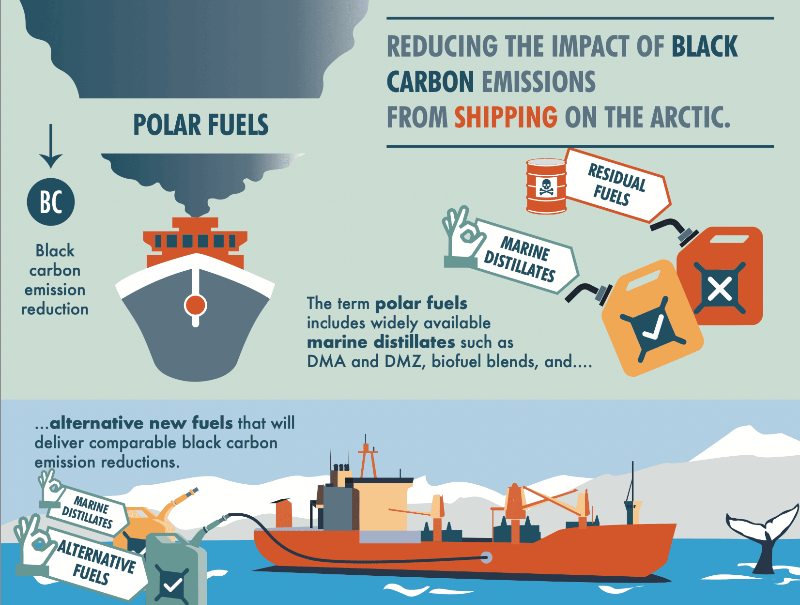
“With a proposal for mandatory regulation for ‘polar fuels’ – currently on the table at the IMO – the EU ambition to cut black carbon from Arctic shipping comes at the perfect moment”, said Dr Sian Prior, Lead Advisor to the Clean Arctic Alliance. “The polar fuels proposal led by Denmark – supported by Greenland, and co-sponsored by Germany, France and the Solomon Islands, if accepted, would ensure that ships will be restricted to using cleaner fuels while sailing in Arctic waters. The EU’s call for a broad definition of Wider Arctic Waters – above 60o latitude north, encompassing the Arctic circle is not only welcome, it demonstrates a clear understanding that black carbon emissions from shipping close to Arctic waters travel further north and have a detrimental impact on land-ice and sea-ice in the region by driving further ice melt and climate warming.”
“Other Arctic, and near-Arctic countries must now follow the EU’s lead by backing the proposal, which is due to be considered during the IMO’s Pollution Prevention and Response Committee in January 2027 (PPR14)”, added Dr. Prior.
(Image from Clean Arctic Alliance)