
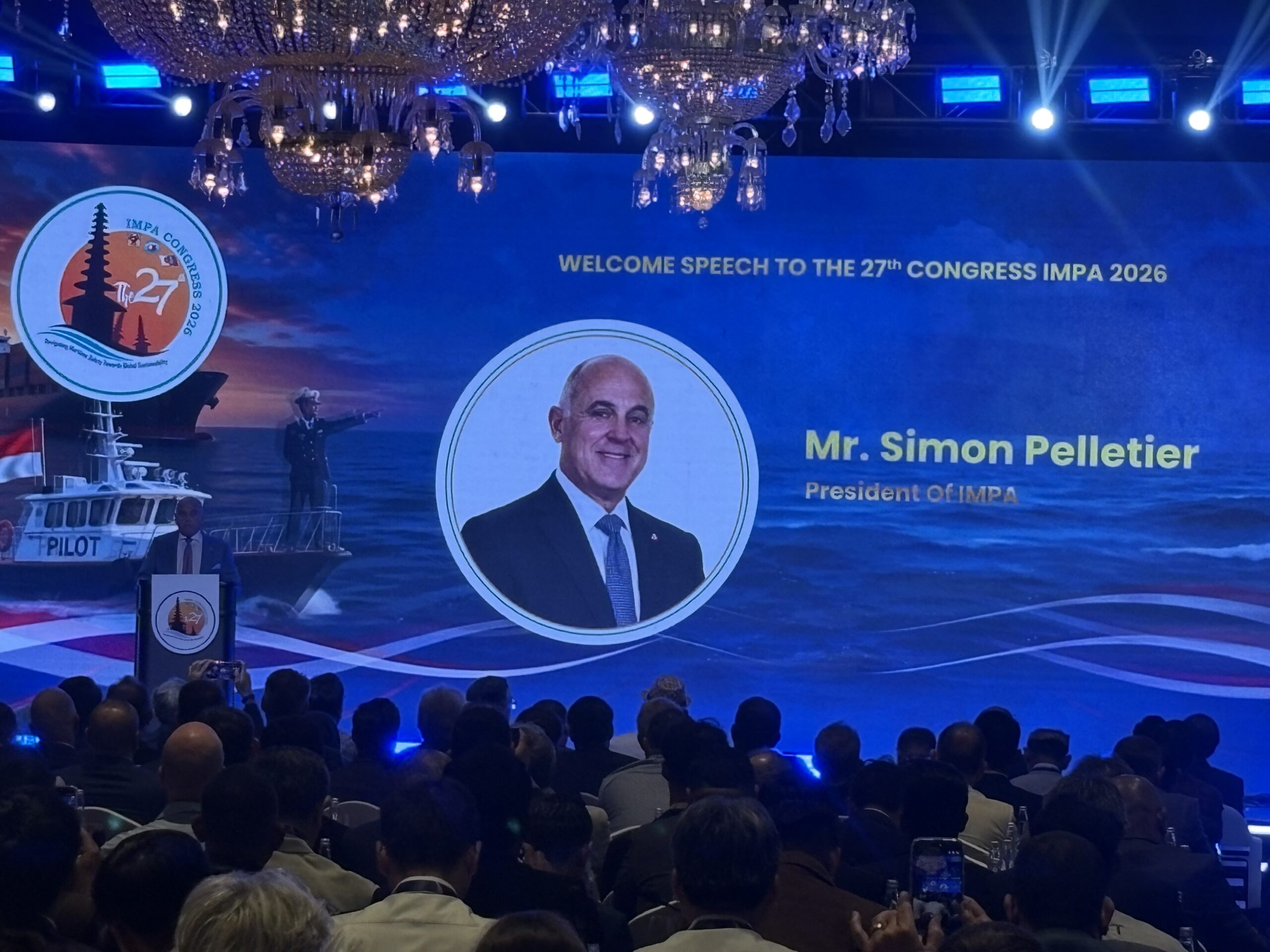
Bali, Indonesia – Unanimously re-elected today for a fourth term of four years as President of the International Maritime Pilots’ Association (IMPA), Captain Simon Pelletier underlined the vital role played by maritime pilots in navigation safety and the need to address challenges faced by pilotage in various parts of the world. His extensive comments were made at the opening ceremony of the 27th Congress of IMPA, which represents more than 8,200 maritime pilots from 53 countries.
Before several hundred delegates, the President of the Canadian Maritime Pilots’ Association began by noting: “IMPA represents the international community of maritime pilots to promote effective safety outcomes in pilotage – an essential public service. Achieving that mission has many components. For one thing, sharing expertise and experience between colleagues is achieved, in good part, through our biennial Congress. That is why we are here – to strengthen pilotage, improve the safety of pilots on duty, and learn from one another’s experience.
“The Congress is also an opportunity to expose our community to wider perspectives from outside the pilotage community. Knowing what is happening in industry, in regulation, in technology, allows us to see what is going on around us, orient ourselves correctly, make informed decisions and act with confidence.
“Everyone here has a shared interest in the safe navigation of ships carrying cargo and passengers. Every day, all over the world, a pilot leaves the shore in a small boat, climbs aboard a moving ship — often in darkness, often in poor weather — and guides that ship safely through the most demanding waters. Into ports. Along rivers. Through narrow channels where local knowledge is everything. In 2025, our community performed an estimated four million such acts of pilotage.
“The pilot never does this alone. Every safe passage is a partnership — with the ship’s master and crew, with vessel traffic services, with tug operators, with the port. A pilot brings the one thing that no one else, no chart, textbook or computer can supply: deep, current knowledge of a particular stretch of water, and the judgment to apply it when conditions change.
“Expert research tells us that pilotage reduces the risk of a navigational accident by a factor of 528. A very serious maritime casualty now occurs only once in every ten million acts of pilotage. And for every dollar spent on pilotage, close to sixty dollars are returned to society — through safety, and through the smooth flow of trade. Few public services demonstrate value on that scale.”
“This week,” Capt. Pelletier continued, “we will explore a wide variety of topics. Safety of pilots on duty is always a feature of our Congress, but this year is different. The adoption of a new mandatory regime for pilot transfer arrangements by the IMO from January 2028 means, more than ever, our own safety culture will be subject to greater scrutiny. We need to talk about how we respond to that scrutiny.
“We will talk about the challenges of ship handling, particularly ultra-large ships in ports where the appetite for larger tonnage outstrips ports’ ability to invest in necessary infrastructure. We will also hear from members of our community about the challenges that come with piloting ships in demanding situations.
“The right data and technology are important enablers of improved performance in pilotage. We will explore the opportunities that data creates, as well as starting a conversation about Artificial Intelligence. Remote pilotage and pilotage as a complex system are two areas in which IMPA is investing in research, and we will hear about the progress of this work too.
“Bridge alerts are a hot topic at the moment, and following on the survey of IMPA members earlier this year and a submission to IMO in June, we will have an opportunity to hear from users and manufacturers and to get a sense of what a future solution for bridge alert management could look like.”
Pilotage faces key challenges
Capt. Pelletier then turned his attention to several important challenges faced by the pilotage community.
“The first is how pilotage should be organised. In some parts of the world, there is pressure to treat pilotage as an ordinary commercial market — to open it to deregulation and competition, in the name of lower costs and supposedly-improved service. When pilotage is viewed through this lens, one thing is for certain: there will be a race to the bottom.
“The value of pilotage as a public safety service will be obscured when only a narrowed focus on its immediate cost prevails. Furthermore, like other services that protect the public interest, pilotage may be under-provided, or under-consumed, if it is not mandated and duly regulated.”
Capt. Pelletier warned: “This is a classical case where, without appropriate regulation, the market will fail and result in a transfer of risk to the public and its social, environmental and economic interests. Deregulation and competition are tools for changing behaviour in markets for commercial services. But pilotage is not a commercial service.”
Technology cannot replace human judgment in severe conditions
The IMPA President subsequently evoked technology as a second challenge requiring close attention.
“Digital tools and artificial intelligence hold real promise, and pilots have always embraced technology that makes us better,” he acknowledged. “But our test is simple: technology is progress only when it solves a real problem and improves performance. I can imagine artificial intelligence helping us in many ways.
“What I cannot imagine is a machine replacing human judgment in conditions of genuine uncertainty — and directing the safe navigation of a great ship is very rarely a predictable task. So, we should meet these tools with cautious optimism, adopting them where they demonstrably improve the safety and effectiveness of pilotage, and rejecting their use where they do not.”
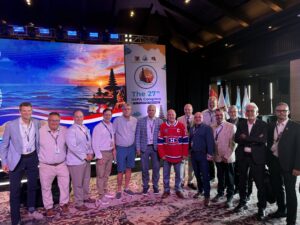
(Images from IMPA, including photo of Capt. Pelletier in symbolic Montreal Canadiens jersey in group photo of Canadian pilot delegates)