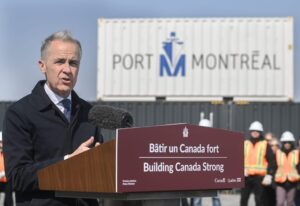

Canada’s largest east coast port expansion moves forward as the Canada Infrastructure Bank (CIB) announced it is supporting the new Contrecoeur container terminal by loaning $1.16 billion to the Montreal Port Authority (MPA). Total cost of the project is estimated at C$2.3B.
From Contrecœur Prime Minister Mark Carney also issued a statement, declaring: “The Contrecœur Container Terminal Project is about more than the expansion of a port – it is a signal that Canada is building again. With each shovel in the ground, we are building a stronger, more independent, more resilient Canadian economy. In less than seven months, this project went from a proposal to a construction site. That is the speed and ambition we need to build Canada strong.”
Canada’s trade future depends on infrastructure that is ready before demand arrives–not after,” said Nathalie Pilon, chair, Montreal Port Authority. “The Contrecœur terminal is exactly that kind of forward-looking investment. It will anchor Montreal’s role as a gateway to global markets. The MPA has worked closely with our federal and provincial partners to bring this project to fruition, and with the help of the private sector, we will deliver lasting value for thousands of companies from all across Quebec and Canada.”
The investment and partnership between the CIB and the MPA will provide Canada with a new public infrastructure of national significance to support future trade growth, an asset paid for through the contribution of private users in the next decades.
The investment will expand container capacity and strengthen Canada’s Eastern Trade Gateway as the Port of Montreal supports Canada’s ambition to double non-U.S. exports and helps bring supply chains back home for Canadian businesses.
The project reflects a strong partnership across governments, the port authority and the private sector. The Government of Quebec is contributing $130 million; Transport Canada $150 million and the full financing will be repaid through autonomous revenues and the contribution of the private sector as terminal operator. Ultimately, more than 85% of infrastructure costs will therefore be borne by the private sector.
Construction of critical in-water works including dredging, quay wall construction and other infrastructure required for vessel access and operations began in October 2025 and is being delivered by a joint venture between Aecon and Pomerleau.
In 2027, work is expected to begin on building out terminal and logistics infrastructure, with commercial operations targeted for 2030. This includes development of the intermodal yard, construction of the terminal and installation of ship-loading equipment at the site, located approximately 40 kilometres northeast of Montreal.
CIB participation helps minimize the project’s cost of capital, allowing the Montreal Port Authority to maintain its investment grade credit rating while preserving cash flows for ongoing operations.
Once complete, the Contrecoeur terminal will add up to 1.15 million twenty-foot equivalent units (TEUs) of annual capacity–about 60% of the Port of Montreal’s current throughput–directly addressing long-term capacity constraints and supporting future growth in container traffic.
DP World is in exclusive discussions with the MPA to serve as terminal operator.
The MPA expects the project will generate thousands of jobs during construction and support hundreds of thousands of jobs linked to the supply chain. More than $750 million in economic benefits are forecasted annually, strengthening supply chain resilience across Canada. This figure captures the operating impact of higher throughput because of Contrecoeur, including incremental activity across terminal operations, marine services, inland logistics, warehousing and related functions generated by the new terminal.
Identified by the federal government as a project of national importance, the Contrecoeur terminal will bolster Canada’s container capacity through its eastern gateway, supporting trade diversification, economic resilience.
The new terminal will offer the shortest shipping route from North America’s industrial heartland to Europe and the Mediterranean, two of the most promising alternative markets for Canadian importers and exporters.
The project also leverages existing transportation infrastructure, including Highway 30 and the CN rail connection, reducing the need for new land-based construction and limiting additional impacts on the surrounding environment. The Contrecœur terminal has been designed to minimize its environmental footprint and meet 388 binding conditions set by the Impact Assessment Agency of Canada.
Endorsements
“Through the Canada Infrastructure Bank, we’re investing in modern, efficient infrastructure that strengthens Canada’s trade corridors and supply chains. The Contrecœur Terminal project will create good jobs, support economic growth and help ensure our transportation networks meet the needs of a robust and growing economy,’ said Gregor Robertson, Minister of Housing and Infrastructure and Minister responsible for Pacific Economic Development Canada.
“Strengthening Canada’s ports to expand trade and grow the economy is a core priority for the Canada Infrastructure Bank. Our loan towards Contrecoeur supports a project of national importance–one of the largest eastern port expansions in Canadian history–and will deliver lasting benefits for Canada’s economy for decades to come,” said Ehren Cory, CEO, Canada Infrastructure Bank.
“The global economy is changing, continuing to impact trade and affordability. That is why we are making long-term, strategic investments that will keep goods moving and costs down for Canadians. By expanding capacity at the Port of Montréal, we are strengthening our supply chains, reducing congestion and ensuring Canadian businesses can compete, grow and prosper, said. Steven MacKinnon, Minister of Transport and Leader of the House of Commons.
“The Contrecœur terminal project marks a turning point for Québec’s economy. By strengthening our port capacity and consolidating our position as a strategic gateway to international markets, we are equipping local businesses with the tools they need to grow, innovate, and diversify their exports. This major investment demonstrates our commitment to building a more resilient, competitive, and forward-looking economy, for the benefit of all regions of Québec,” said Jean Boulet, Minister of Economy, Innovation and Energy, and Minister Responsible for Maritime Strategy, Government of Quebec.