

An alarming rise in cargo theft and freight fraud across global supply chains is being highlighted by the International Union of Marine Insurance (IUMI) and the Transported Asset Protection Association (TAPA) EMEA, with incidents escalating across Europe, the Americas and Africa. Latin America and several African nations are experiencing particularly severe and violent attacks.
IUMI and the Transported Asset Protection Association (TAPA) EMEA call for urgent action by supply chain stakeholders and government authorities to combat the growing risk of fake carriers and other cargo crime tactics.
Fraudulent pickups have particularly impacted supply chains in Europe, North and South America, with violent modus operandi being most prevalent in Africa and Latin America. While it is true that the growth of these types of events in Europe and the US has been alarmingly fast, it is equally true that (albeit more gradually) the same trend is emerging across all regions around the world.
Recent data highlights an alarming trend for cargo theft generally and freight fraud in particular. The losses indicate that cargo crime has moved “from the asphalt to cyberspace”, with criminals increasingly using digital tools to conceal their true identities and shift from physical theft and violent hijackings to sophisticated online fraud.
Cargo theft losses in North America reached USD 455 million in 2024, with over 3,600 reported incidents. The average loss per incident exceeds USD 202,000.
TAPA EMEA’s cargo crime intelligence database recorded over 108,000 thefts from supply chains in more than 110 countries in Europe, the Middle East and Africa in the last two years. The 5% of these crimes reporting their loss value were worth a combined €1 billion+, the equivalent of >€1.3m every 24 hours. Major incidents (€100K+) averaged €878,525.
Strategic cargo theft and organised crime account for around 18% of all thefts in the US as criminals adopt increasingly sophisticated tactics to attack supply chains.
“Phantom freight” frauds have surged in Mexico. According to the American Transportation Research Institute (ATRI), this kind of strategic theft skyrocketed (up to 15 times) since 2022. Notorious cases involved stealing high-value shipments (e.g., truckloads of tequila) through fraud, with no violence used.
Criminal groups increasingly focus on the fraudulent theft of truck consignments by securing regular freight contracts under false or misused identities. They set up shell companies, hijack or impersonate legitimate firms, or operate under stolen credentials so that, at the point of collection, everything appears to be a normal transport. Once they have taken charge of the goods with the intent to steal them, the contract is not fulfilled. The consignment does not reach its intended recipient and is instead resold elsewhere.
By this stage, the ostensible business partner has vanished without a trace. The method is low risk and high reward because the cargo is handed over voluntarily. Offenders rely on simple but effective digital deception: spoofed or forged email addresses, look‑alike domains, fake insurance certificates, and counterfeit driver credentials.
Access to freight exchanges or company systems is increasingly obtained by compromising user accounts through phishing, password reuse, or other credential attacks. While AI is not central to current cases, emerging AI tools can streamline document forgery, identity obfuscation, and credential harvesting, making these schemes easier to scale and potentially driving larger losses over time. It is not only one‑off contracts that are affected. Repeat bookings and framework agreements are also targeted, which increases the potential severity of losses.
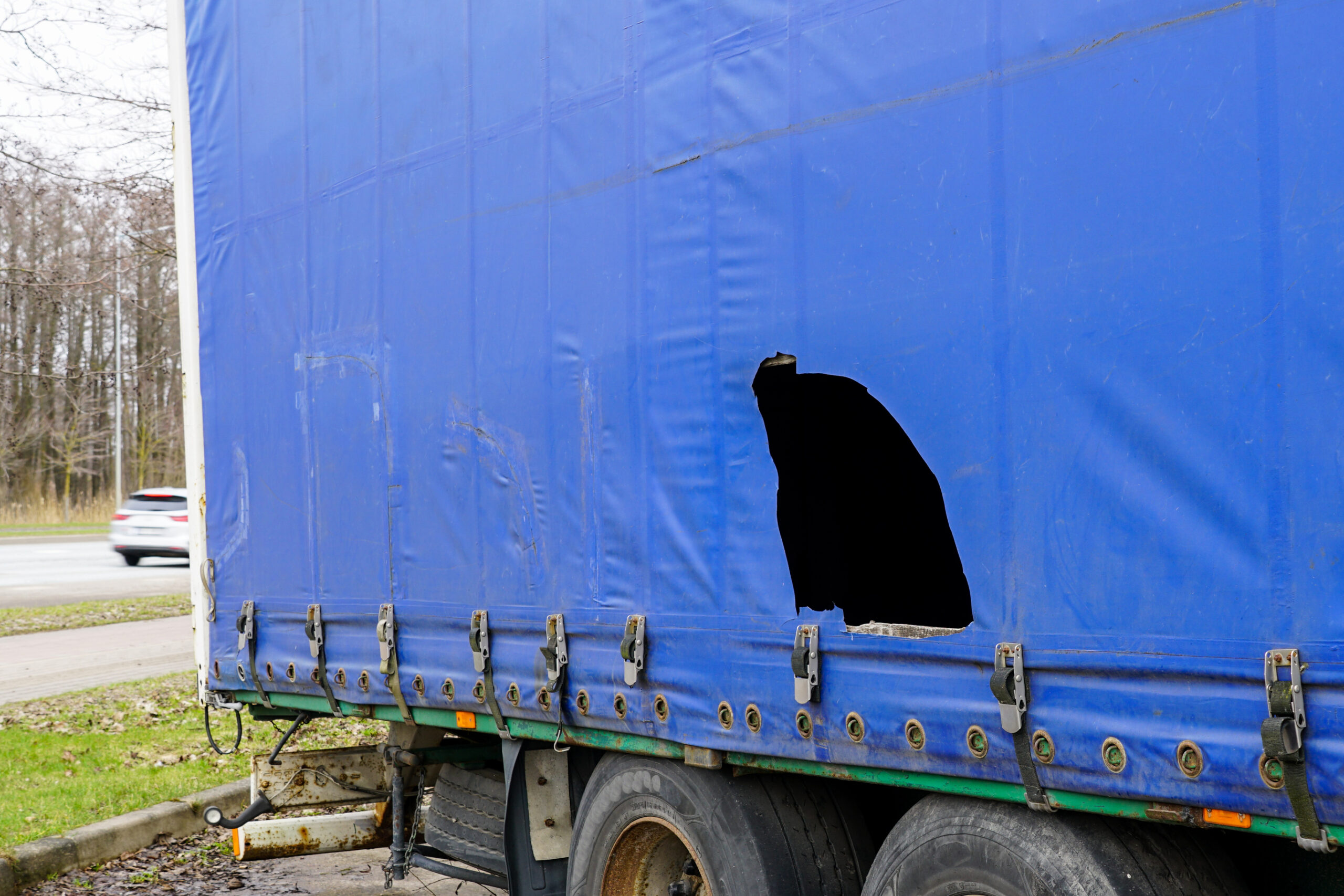
(Dreamstime photo of cargo theft on truck trailer)