

New York – While attending the 81st Session of the United Nations General Assembly (UNGA) and other events in New York this week, Prime Minister Mark Carney announced Canada’s ratification of the High Seas Treaty and called for wide support to strengthen global ocean observation.
At an OceanEye International Alliance event co-hosted with the President of the European Commission, Ursula von der Leyen, Prime Minister Carney mobilised international support to strengthen global ocean observation. As co-chair of the Alliance, the Prime Minister emphasised the role of ocean monitoring in strengthening maritime safety, supporting sustainable ocean economies, responding to climate change, and protecting ecosystems.
“The ocean we share cannot be understood, or protected, by any nation alone,” Mr. Carney said.
“What none of us can do individually, we can achieve together. Every observation shared multiplies impact. That is what this Alliance builds: a picture none of us could see by ourselves, and none of us can afford to lose.”
The event brought together heads of state and governments, ministers and stakeholders, to strengthen support for global ocean observation. Reliable ocean observation is essential for safe navigation, weather forecasting, climate predictions, coastal protection and a thriving blue economy.
The event was organised in partnership with the Intergovernmental Oceanographic Commission of UNESCO (IOC UNESCO) and the World Meteorological Organization (WMO), the two co-sponsoring organisations of GOOS, both of which stand to benefit from stronger global ocean observation.
The European Union (EU) pledged funding of €92 million for Ocean observation activities while Canada pledged $82 million over five years to expand Canada’s ability to observe the oceans.
So far, the event secured over $339 million (€211 million) from all partner countries with a mix of financial contributions, in kind support, and the provision of assets such as research vessels, sensors, drones and data processing facilities.
The pledges will support:
- the maintenance of existing observation platforms;
- the closure of critical data gaps;
- the strengthening of the GOOS Secretariat;
- the GOOS coordination hubs;
- and the reinforcement of the OceanOPS data reporting centre.
A total of 31 members have joined the OceanEye International Alliance, including Canada, the EU and 29 countries (Angola, Belgium, Brazil, Chile, Colombia, Cabo Verde, Costa Rica, Croatia, Cyprus, France, Germany, Greece, Iceland, Ireland, Italy, Madagascar, Malta, Mauritius, Mexico, Norway, Namibia, Palau, Portugal, Slovenia South Korea, Spain, the Netherlands, the Faroe Islands and the United Kingdom).
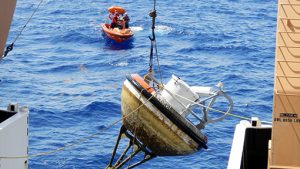
The Global Ocean Observing System (GOOS), co sponsored by IOC UNESCO and the WMO, delivers around 120,000 observations per day from 8,000 platforms operated by 64 countries and 17 global observation networks.
High Seas Treaty ratification
Prime Minister Carney announced Canada’s ratification of the Agreement on Marine Biological Diversity of Areas beyond National Jurisdiction, also known as the High Seas Treaty, backed by over $24 million to implement the treaty and help protect and sustainably manage marine biodiversity in international waters.
The Treaty officially entered into force on January 17, 2026 after reaching the threshold of 60 country ratifications. Applying to the high seas and deep seabed, which make up roughly two-thirds of the global ocean, it is a legally binding international agreement under the United Nations Convention on the Law of the Sea (UNCLOS).
The United States, which signed the Treaty in 2023, remains a non-party participant. The treaty was sent to the U.S. Senate on December 18, 2024, but it remains unratified. Full ratification requires a two-thirds majority vote for “advice and consent” in the U.S. Senate before it can be sent to the President for final ratification.
At the United Nations General Assembly (UNGA), Prime Minister Carney announced Canada’s endorsement of the Annual Joint Leaders’ Communiqué on Ocean-Climate. With Canada preparing to host the next Our Ocean Conference in 2027, Prime Minister Carney underscored the need for coordinated international action to advance a sustainable ocean economy and address the interconnected challenges facing the oceans and climate. The conference will be held in Halifax from May 10 to 11, 2027, alongside a youth summit. It will be chaired by Canada’s new Ocean Envoy, Diana Fox Carney.
(Photo from Global Ocean Observation System)