
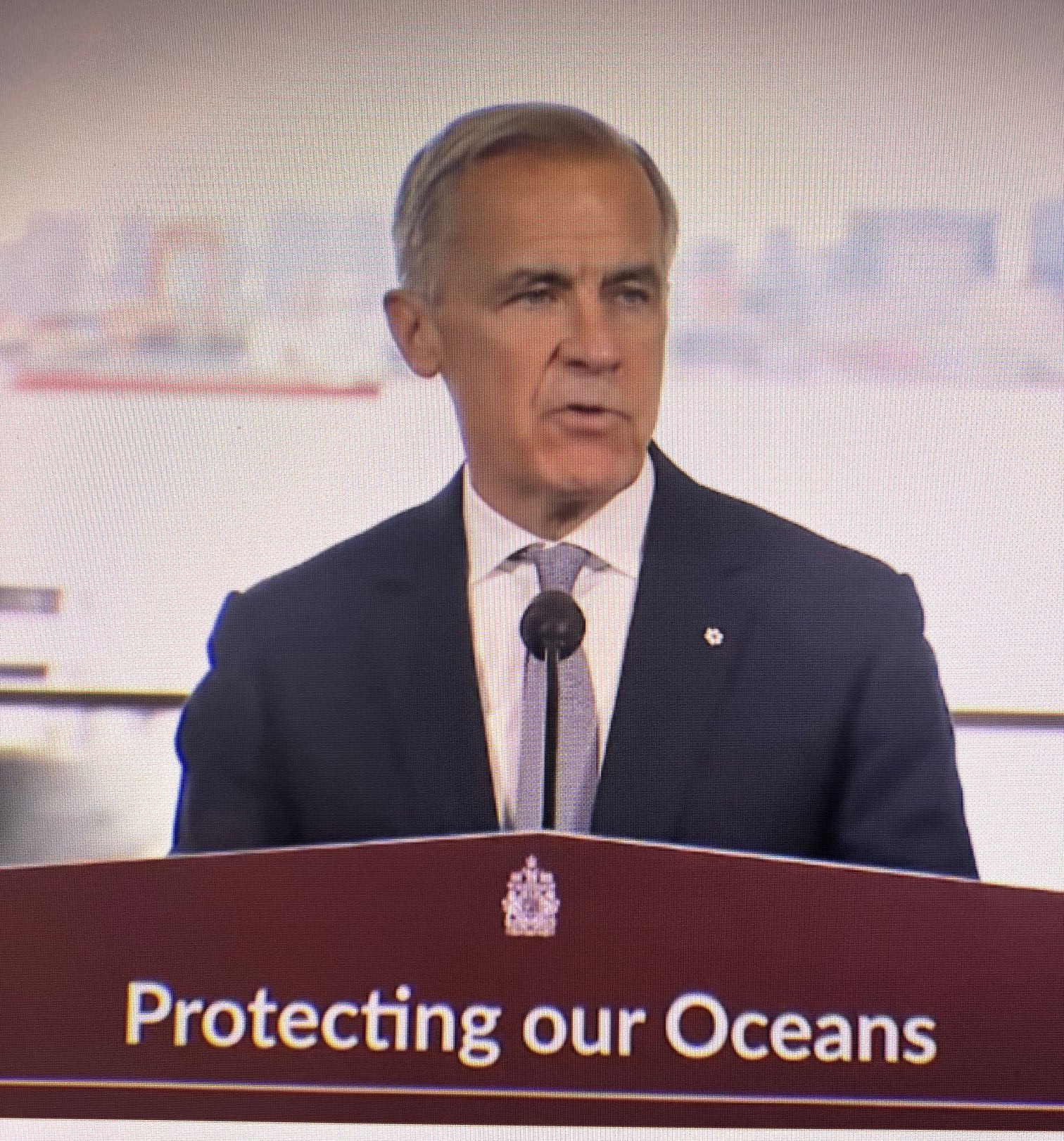
Within the context of a developing national ocean strategy, Prime Minister Mark Carney has announced an investment of $1.2 billion to better protect Canada’s oceans and the life they sustain. The measures renewed and introduced on September 29 will increase monitoring, strengthen ocean science and ecosystem protections, and improve marine incident prevention and preparedness.
“We are expanding our strategic infrastructure along the West Coast, including the Port of Vancouver and the Roberts Bank Terminal 2,” Mr. Carney said in North Vancouver. “While this will help diversify our trade and reinforce our sovereignty, it will also place increased pressure on our ocean ecosystem. Canada must be prepared. To effectively and sustainably build out our marine infrastructure, we will first protect our oceans.”
“Healthy oceans depend on the people who protect them,” stated Joanne Thompson, Minister of Fisheries. “These historic investments will give our conservation and protection officers modern tools to protect our oceans, coastlines, and natural habitats.”
The measures build on the ambitious work underway that is cementing Canada’s position as a global leader in ocean conservation. The government’s landmark initiatives so far include a new nature strategy, A Force of Nature, to protect 30% of Canada’s oceans by 2030, an Atlantic salmon program and a renewed Pacific Salmon Strategy Initiative, and nearly $260 million in new measures to protect whales from vessel traffic and noise. To date, the Government of Canada has invested $3.2 billion in new systems, research, and personnel that will protect our oceans and marine life.
To accelerate and expand that work, the Prime Minister announced the following new investments:
- As marine traffic grows, Canada’s new government will invest more than $740 million over the next four years to strengthen ocean conservation. We will:
- Renew several existing measures in the Oceans Protection Plan that advance marine science, protect ecosystems, and strengthen incident prevention and preparedness.
- Expand the Canadian Coast Guard’s capacity to monitor marine traffic and strengthen search and rescue stations with more integrated marine response capabilities.
- Extend very high frequency (VHF) radio and radar coverage to areas where it is limited.
- Develop a national high-resolution nearshore forecasting system to improve real-time emergency response.
- Establish a new environmental recovery framework on all coasts for long-term recovery from marine pollution incidents, expanding coverage from oil spills to other chemical hazards.
- Modernise marine safety and oversight systems for inspections and certification, with a goal of reducing compliance costs by 20%.
- Modernise conservation and protection enforcement by increasing front-line capacity, equipping conservation and protection officers with modern tools like body-worn cameras, drones, and protective gear, providing specialised training, and upgrading outdated systems.
- To specifically protect marine life, Canada’s new government will build on the recent renewal and enhancement of whale protection measures and invest a further $136 million over the next four years to:
- Develop a national marine mammal oil spill response plan and strengthen local partner readiness with training and equipment so we can act quickly to protect marine mammals and their habitats in the event of a spill.
- Enhance long-term capacity to monitor, assess, and mitigate underwater noise across the Pacific and Arctic, and on the East Coast.
- This includes working with companies and individual owner-operators to reduce noise with proven technologies, such as low-noise propellers, electric and hybrid motors, and hull improvements to make vessels more hydrodynamic.
- Establish an Arctic monitoring program to understand baseline and future noise, assess mitigation measures, and inform major project reviews and regional planning.
- To strengthen Indigenous partnerships and conservation efforts on the West Coast, the government will:
- Invest $186 million for the Northern Shelf Bioregion Reconciliation Framework Agreement. This will advance collaborative governance, conservation, waterway management, emergency preparedness, and cumulative effects work in the critical Great Bear Sea region.
- The government is also investing in Indigenous-led stewardship and restoration of the Lower Fraser River Estuary.
“In the coming months,” Mr. Carney said, “the government will release the other two pillars of Canada’s ocean strategy: our plans to secure our waters and to build our ocean economy. Much of this work is underway, with historic investments to strengthen our ports, small craft harbours, and fisheries. All of this work will accelerate as Canada prepares to welcome the world (in Halifax) for the 12th Our Ocean Conference in May.”
(Screen photo of Mark Carney speaking in Vancouver)